TL;DR:
- Context learning connects knowledge to meaningful real-world situations, enhancing retention and skill transfer in both humans and AI systems. Human education benefits from authentic, immersive experiences, while AI models like GPT-4 use pattern recognition through embedded examples to perform new tasks temporarily. Advancing from transient in-context adaptation to lasting context learning is essential for developing more effective, continuously improving educational and AI systems.
Context learning is defined as the process of acquiring and retaining knowledge by embedding new information within meaningful, real-world situations or tasks. This approach works across two distinct domains: human education, where it connects academic content to lived experience, and artificial intelligence, where large language models like GPT-4 adapt to new tasks by interpreting examples directly within their input prompts. Both forms share a core goal: make information stick by giving it a home in reality. Understanding how context learning works in each domain gives educators, learners, and AI researchers a sharper set of tools for designing better outcomes.
What is context learning and how does it work in education?
Contextual learning in education, often formalized as Contextual Teaching and Learning (CTL), connects academic content to learners’ real-life experiences and goals, promoting motivation and retention through active participation rather than rote memorization. The theory rests on two foundational pillars: situated cognition and scaffolding. Situated cognition holds that knowledge is inseparable from the context in which it is learned. Scaffolding provides structured support that gradually fades as learners gain competence.
CTL improves critical thinking and problem-solving by integrating disciplinary content with real-world problems, representing a clear shift from passive memorization toward active learner engagement. This matters because retention rates from passive learning methods drop sharply within 48 hours. When a chemistry teacher frames a lesson on oxidation around rust on a bicycle rather than abstract equations, students form associations that survive beyond the exam.
Active participation methods that drive contextual learning include:
- Project-based learning: Students solve a genuine community problem, such as designing a water filtration system, using science and math skills in tandem.
- Simulations: Medical schools use patient simulators so students practice diagnosis before entering a clinical setting.
- Collaborative tasks: Group problem-solving mirrors workplace dynamics, building both content knowledge and communication skills.
- Field trips: Visiting a local ecosystem turns abstract ecology concepts into observable, memorable phenomena.
The data on outcomes is specific. A 2025 manufacturing simulation study showed a 30% reduction in technical errors when adult learners trained using real-world data and contexts compared to traditional methods. That figure reflects more than engagement. It reflects genuine skill transfer, the ability to apply knowledge outside the classroom where it actually counts.
One critical pitfall educators must avoid is false contextualization. Linking lessons to forced or irrelevant scenarios reduces the effectiveness of contextual learning because authenticity drives motivation. A finance lesson framed around a fictional country with no connection to students’ lives produces weaker results than one built around their own spending decisions.
Pro Tip: When designing a contextual lesson, ask yourself whether a working professional in that field would recognize the scenario as realistic. If the answer is no, rebuild the context before you build the content.
What is In-Context Learning (ICL) in AI and how does it function?
In-Context Learning (ICL) in AI is a mechanism that allows models like GPT-4 to perform new tasks by processing examples or instructions within the prompt, without model fine-tuning or weight changes. This is the AI equivalent of handing someone a few worked examples before asking them to solve a new problem. No retraining. No updating the underlying system. Just pattern recognition applied to what is already in front of the model.
Here is how ICL works step by step:
- Prompt construction: A user embeds one or more examples of a task directly into the input. This is called few-shot prompting. One example is one-shot learning; no examples is zero-shot.
- Pattern recognition: The transformer architecture reads the examples and infers the structure of the task, identifying relationships between inputs and outputs.
- Inference-time adaptation: The model generates a response consistent with the inferred task pattern, without any change to its underlying weights.
- Result delivery: The output reflects the task as demonstrated in the prompt, not a new capability the model has permanently acquired.
ICL exploits statistical pattern matching, an emergent behavior in transformers, meaning it was not explicitly programmed but arose from training on massive text corpora. This is why GPT-4 can translate a sentence into formal legal language after seeing just two examples in the prompt, even if that specific style was never a discrete training objective.
“ICL bridges static pretrained models and the dynamic needs of real-world tasks by identifying patterns from few examples during inference.” — IBM Research
The limitations of ICL are real and worth naming. The adaptation is temporary. Once the conversation ends, the model retains nothing from the exchange. Context window constraints also cap how many examples you can embed, which limits complexity. For tasks requiring deep domain expertise, ICL alone is insufficient.
This is where the concept of context learning as an evolution of context engineering becomes relevant. Context learning converts transient retrieval gains into lasting parametric memory in AI models, aiming to build systems that improve continuously rather than relying solely on fixed pretrained knowledge. The distinction matters for anyone building AI-powered educational tools: a system that only uses ICL forgets every lesson; a system that incorporates context learning retains them.
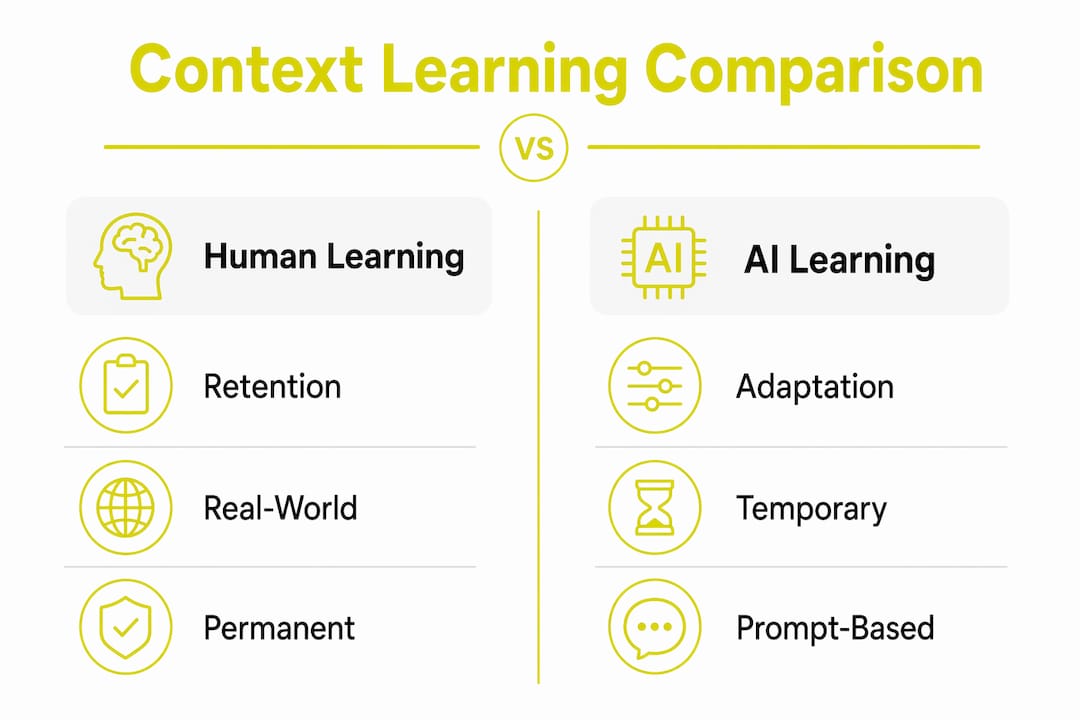
How do human contextual learning and AI in-context learning compare?
Both forms of context learning pursue adaptability through relevant examples, but their mechanisms and outcomes differ in fundamental ways.

| Aspect | Human contextual learning | AI in-context learning (ICL) |
|---|---|---|
| Purpose | Build lasting understanding and real-world skill transfer | Adapt model output to a specific task at inference time |
| Process | Active engagement with authentic scenarios, scaffolding, reflection | Pattern recognition from examples embedded in the prompt |
| Permanence | Knowledge consolidates into long-term memory through practice | Adaptation is temporary; no weight updates occur |
| Examples | Field trips, simulations, project-based learning | Few-shot prompting, one-shot prompting, zero-shot prompting |
| Benefits | Deeper retention, critical thinking, motivation | Rapid task adaptation without expensive retraining |
| Challenges | False contextualization, resource intensity, teacher training | Context window limits, no persistent memory, prompt sensitivity |
The most instructive contrast is permanence. Human learners who work through a real problem consolidate that experience into memory through sleep, retrieval practice, and application. An AI model using ICL produces an excellent output and then forgets the entire exchange. This is not a flaw in the model. It is a design characteristic of current transformer architectures.
For educators building AI-powered tools, this comparison carries a direct implication. Relying on ICL alone to personalize learning experiences produces a system that cannot grow with the learner. The shift toward context learning in AI is critical for building models that learn continuously rather than relying solely on fixed pretrained knowledge. Educators and AI practitioners who understand this distinction will build better adaptive systems.
Practical examples of context learning in language acquisition
Language acquisition is where contextual learning delivers some of its most measurable results. Contextual cues boost recall by approximately 20% in assessments, improving vocabulary use and fluency through embedding language in authentic scenarios like live dialogues. That 20% gain compounds over time, particularly for learners who engage with a language daily.
Real-world contextual learning examples in language education include:
- Music-based learning: Lyrics provide grammar patterns, idiomatic expressions, and cultural references in a format the brain processes emotionally as well as linguistically. Music significantly improves vocabulary retention and learner engagement by acting as a memorable, cultural context that facilitates language acquisition.
- Immersive conversation practice: Platforms that connect learners with native speakers place vocabulary inside real social contexts, where stakes and emotion reinforce memory.
- Film and media analysis: Watching a Spanish film with Spanish subtitles forces learners to process grammar and vocabulary simultaneously within a narrative context.
- Role-play simulations: Practicing ordering food in a restaurant or negotiating a price at a market gives learners scripts they can immediately transfer to real situations.
The role of technology in supporting contextual language learning has expanded significantly. Apps that use spaced repetition, karaoke-style lyric practice, and interactive quizzes embed vocabulary inside context rather than presenting it as isolated lists. The difference in retention between a word learned in a sentence and a word learned on a flashcard alone is substantial.
| Learning method | Context type | Retention advantage |
|---|---|---|
| Music and lyrics | Cultural and emotional | High: emotional encoding strengthens recall |
| Live conversation | Social and situational | High: real stakes activate attention |
| Simulations and role-play | Task-based | Medium-high: procedural memory activated |
| Isolated vocabulary lists | None | Low: no associative anchor |
Pro Tip: When learning vocabulary in a new language, always find the word used in a song lyric, a film line, or a real conversation before moving on. One authentic example outperforms ten repetitions of a word in isolation.
For learners building their own study systems, vocabulary retention with music offers a practical framework for applying contextual principles to daily practice. The key is consistency: context learning requires repeated exposure within varied but authentic situations to produce durable results.
Key takeaways
Context learning works because meaningful, real-world situations create the associative anchors that make knowledge both retrievable and transferable, whether the learner is human or an AI model.
| Point | Details |
|---|---|
| Definition spans two domains | Context learning applies to both human education (CTL) and AI systems (ICL), with distinct mechanisms in each. |
| Authenticity is non-negotiable | False or forced contexts reduce motivation and retention; genuine relevance drives outcomes. |
| AI ICL is temporary by design | GPT-4 and similar models adapt at inference time without retaining knowledge after the session ends. |
| Music accelerates language acquisition | Lyrics embed vocabulary in cultural and emotional context, producing measurably higher retention than isolated study. |
| Permanence separates human and AI learning | Human contextual learning consolidates into long-term memory; AI context learning requires architectural advances to achieve the same. |
Why context learning deserves more credit than it gets
Most educators I speak with understand contextual learning as a pedagogical preference, a nice-to-have rather than a structural requirement. That framing undersells it badly. The research on situated cognition is not ambiguous: knowledge acquired without context is fragile. It survives tests and disappears under real-world pressure.
What I find most overlooked is the parallel between how humans and AI systems both fail without context. A student who memorizes vocabulary lists cannot hold a conversation. A language model given a task with no examples produces generic output. Both failures have the same root cause: absence of meaningful context at the moment of learning or inference.
The most exciting development I see is the convergence of these two domains. Platforms that combine authentic cultural context, music, social interaction, and spaced repetition are not just more engaging. They are architecturally closer to how the brain actually consolidates language. The game-based and contextual learning approaches emerging in educational technology reflect this understanding, moving away from drill-and-kill toward systems that mirror real acquisition.
My honest concern is that AI-powered language tools will lean too heavily on ICL’s convenience without addressing its impermanence. A tool that adapts brilliantly in a single session but forgets everything is not a learning partner. It is a very sophisticated flashcard. The field needs to push harder toward context learning architectures that build on each interaction rather than resetting after every conversation.
— Ben
Learn languages in context with Singwithcanary
Singwithcanary applies context learning principles directly to language acquisition by combining song lyrics, karaoke practice, interactive quizzes, and vocabulary cards into a single, culturally immersive experience. Every feature is designed to place new words and grammar patterns inside authentic musical and social contexts, the exact conditions that produce durable retention.
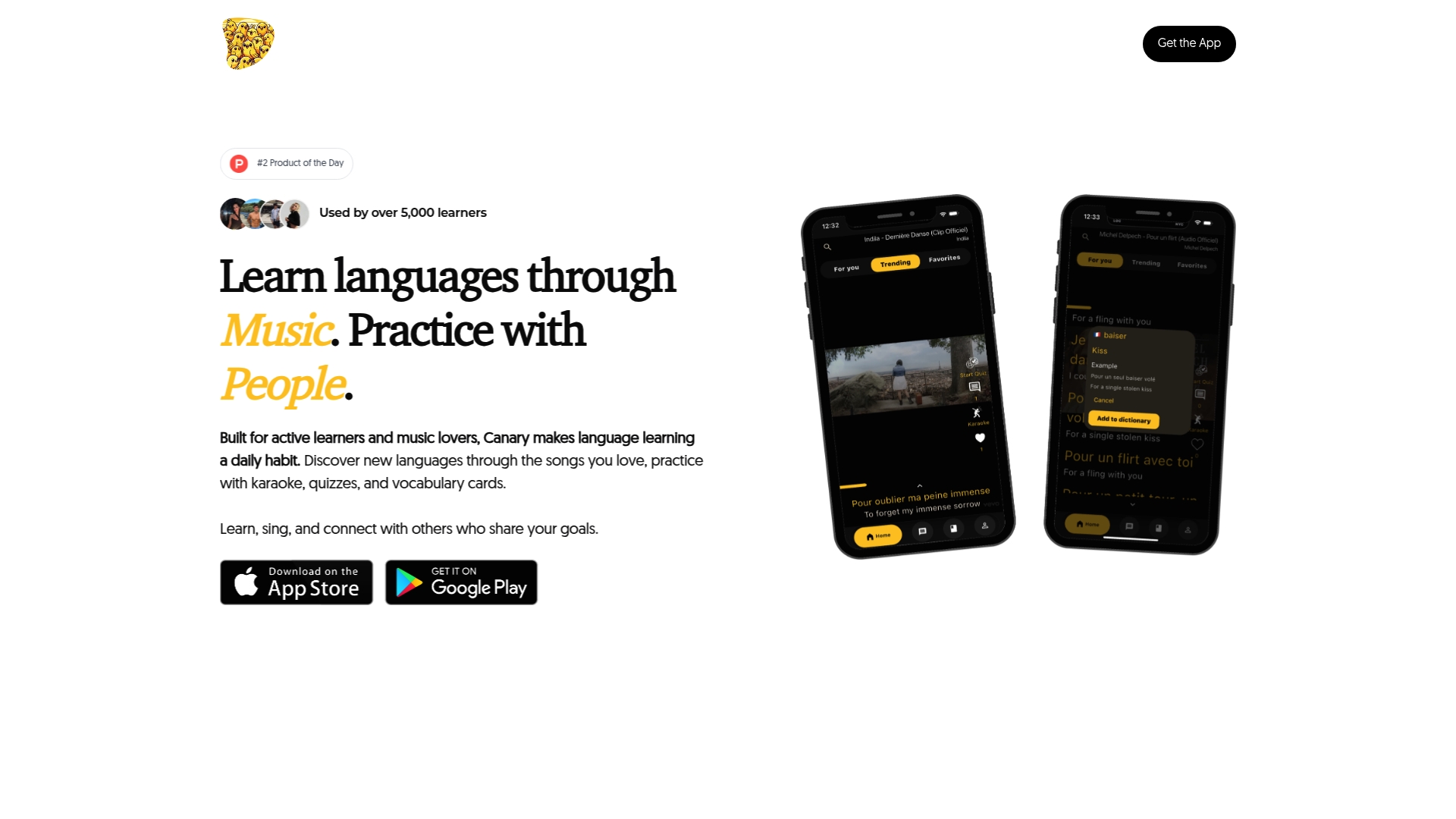
If you want to learn languages with music and practice with speakers from around the world, Singwithcanary gives you the contextual framework that isolated apps cannot. The platform’s community-driven approach means you are not just memorizing words. You are using them in real exchanges, with real cultural weight behind every lyric. Start building your contextual language habit today.
FAQ
What is the definition of context learning?
Context learning is the process of acquiring and applying knowledge by embedding new information within meaningful, real-world situations or tasks. In education, it is formalized as Contextual Teaching and Learning (CTL); in AI, it refers to In-Context Learning (ICL), where models adapt to tasks using examples in the prompt.
How does In-Context Learning work in AI models?
ICL allows models like GPT-4 to perform new tasks by processing examples embedded directly in the prompt, without updating model weights. The model recognizes patterns from those examples at inference time and generates output consistent with the demonstrated task.
What are the main benefits of contextual learning in education?
Contextual learning improves retention, critical thinking, and real-world skill transfer by connecting academic content to authentic scenarios. Studies show it can reduce technical errors by 30% in applied training settings compared to traditional instruction.
Why is music effective for contextual language learning?
Music embeds vocabulary and grammar inside cultural and emotional contexts, which the brain processes more deeply than isolated word lists. Research shows contextual cues, including musical ones, can boost recall by approximately 20% in assessments.
What is the difference between context engineering and context learning in AI?
Context engineering provides temporary task information during a single inference session, while context learning aims to convert those gains into lasting parametric memory. The shift toward context learning is critical for building AI models that improve continuously rather than resetting after each interaction.