TL;DR:
- Language immersion involves active, meaningful exposure to a target language within context, not just living abroad. It emphasizes interaction, comprehensible input, and daily practice to promote implicit, fluent acquisition for learners of all ages. Effective strategies include engaging with media, social interaction, music, and consistent, scaffolded efforts, exemplified by programs and platforms like Singwithcanary.
Most people assume language immersion means packing a bag and moving abroad. That assumption misses the point almost entirely. What is language immersion, really? At its core, it’s a method of language learning built around sustained, meaningful exposure to a target language in context. You don’t absorb a language by sitting next to it. You acquire it by interacting with it, processing it, and producing it. This article unpacks the real definition, the science behind why it works, the different models available, and how you can apply immersion principles starting today.
Table of Contents
- Key takeaways
- What language immersion actually means
- Types of immersion programs and models
- Benefits of language immersion and common myths
- How to build your own immersion strategy
- My honest take on what actually works
- Practice immersion daily with Singwithcanary
- FAQ
Key takeaways
| Point | Details |
|---|---|
| Immersion requires active engagement | Being surrounded by a language means nothing without meaningful interaction and comprehensible input. |
| The i+1 principle drives acquisition | Language slightly beyond your current level, understood in context, is the sweet spot for real learning. |
| Multiple immersion models exist | From dual-language school programs to self-directed daily practice, immersion takes many practical forms. |
| Native language is not the enemy | Effective programs integrate both languages, not eliminate the first one. |
| Music and social interaction accelerate progress | Repeated, emotionally engaging input through song and conversation deepens retention and confidence. |
What language immersion actually means
Language immersion, by definition, is a method of instruction and practice where the target language serves as the primary vehicle for communication, not just the subject being studied. The language immersion definition matters because it separates immersion from translation-based study, where your first language acts as the constant reference point.
The foundational theory comes from linguist Stephen Krashen. His comprehensible input hypothesis, specifically the concept of i+1 language acquisition, argues that you acquire language when you understand messages that are slightly beyond your current level. Not so easy that there’s no growth. Not so hard that comprehension collapses. The zone just past what you know, made accessible through context, visuals, repetition, or prior knowledge.
What makes this different from a typical grammar class? Implicit acquisition. In immersion, you internalize patterns by encountering them repeatedly in real contexts, much like a child picks up their first language. Explicit instruction, where someone explains a rule and you memorize it, can support learning but rarely drives fluency on its own. Immersion prioritizes contextual interaction over grammar drills, which is why learners in strong programs often develop intuitive fluency that textbook learners never reach.
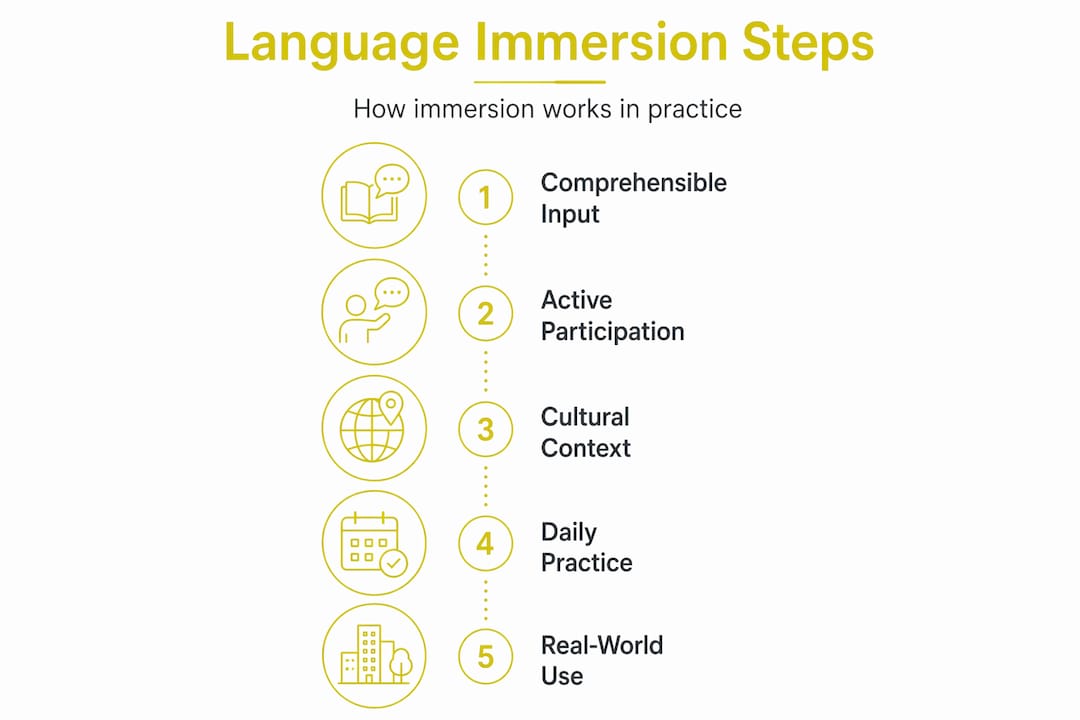
Here’s what this means in practice:
- Comprehensible input first. You need content you can roughly understand, even if you don’t catch every word.
- Active over passive. Listening to background TV in another language is not immersion. Watching a show and working to understand what’s happening is closer.
- Production matters. Responding, writing, and speaking push acquisition faster than pure receptive exposure.
- Consistency over intensity bursts. An hour every day outperforms seven hours once a week.
Pro Tip: When you encounter a new phrase in context and understand it without translating it in your head, that’s immersion working. Track those moments. They compound quickly.
Types of immersion programs and models
Not all immersion looks the same. The approach varies by age, context, and learning goal. Knowing the different models helps you identify what fits your situation.
| Model | Key feature | Best for |
|---|---|---|
| Dual-language immersion | Instruction in two languages aiming for bilingual proficiency | School-age learners seeking bilingualism |
| One-way immersion | All students are non-native speakers of the target language | Structured school or program settings |
| Total immersion | 100% target language instruction at least in early phases | Intensive early childhood programs |
| Self-directed immersion | Learner-created exposure through media, apps, and interaction | Adults and independent learners |
| Travel-based immersion | Geographic relocation combined with active language use | Motivated learners with access and time |
Dual-language immersion is arguably the most studied model in schools. California’s approach, for example, is explicitly additive bilingualism: students add a second language without replacing their first. This matters because it pushes back against the myth that immersion requires abandoning your native tongue.
What is total immersion? It refers to the practice of conducting all instruction in the target language, at least during the early stages. Richmond School District’s French Immersion program demonstrates this well. Students receive 100% French instruction through grade 2, then gradually shift to a bilingual balance as English language arts are introduced in later years. The reasoning is deliberate: early total immersion builds a strong foundation before introducing the dominant language.

Real-world results back this up. Thomas Jefferson Elementary School in Anaheim runs a Korean dual immersion program where non-native students achieve fluency through consistent, structured dual-language exposure. The students didn’t move to Korea. The immersion came to them, built into their daily school environment.
For adults without access to structured programs, self-directed immersion is the path. This is what is immersive language practice in its most flexible form: building an environment around your life where the target language appears constantly and demands your active response.
Benefits of language immersion and common myths
The benefits of language immersion go well beyond vocabulary gains. Research consistently shows that bilingual learners develop stronger mental flexibility, sharper attention control, and a heightened ability to think about language itself (called metalinguistic awareness). These advantages show up in academic performance, problem-solving, and even long-term cognitive health.
There are also purely linguistic benefits. Learners in immersion programs develop more natural pronunciation, better grammar intuition, and stronger listening comprehension than those who study a language as a separate subject. Because they process language in context across subjects and conversations, the language becomes woven into their thinking rather than sitting in an isolated mental folder.
Fluency isn’t knowing every word. It’s building the reflex to understand, respond, and adapt. Immersion trains the reflex. Grammar study only trains the knowledge.
But there are persistent myths worth clearing up directly.
- Myth: Immersion means no native language. Wrong. Successful programs integrate both languages and protect first-language literacy. Dropping your native language doesn’t accelerate second-language acquisition. It just creates anxiety and gaps.
- Myth: Just living abroad creates immersion. Being physically surrounded by a language doesn’t guarantee acquisition. Active engagement is what creates immersion, not geography. Plenty of expats live abroad for years without gaining real fluency because they never pushed beyond transactional interactions.
- Myth: Passive listening counts as immersion. Putting a podcast on while cooking is pleasant. It’s not immersion. Your brain processes background noise differently than focused, comprehension-seeking listening.
- Myth: Immersion only works for children. Adults learn differently, but they acquire language through the same mechanisms. Adults actually have advantages in motivation, strategy, and the ability to seek out content they find genuinely interesting.
The dual-language approach delivers bilingual proficiency across academic content, not just conversational ability. That’s a meaningful distinction if your learning goals include professional or academic use of a second language.
How to build your own immersion strategy
You don’t need a school program or a plane ticket. What you need is a plan that creates frequent, contextual contact with your target language. Here’s how to build it.
- Establish your comprehensible input sources. Choose media, podcasts, or shows at a level you can follow with effort. Comprehension-seeking matters more than the format. YouTube channels, graded readers, and song lyrics with context all qualify.
- Add structured interaction. Language learning through social interaction is one of the fastest ways to push acquisition. Find native speakers online, join language exchange communities, or use platforms built around social practice.
- Use music as a repeated input tool. Songs give you the same words and phrases dozens of times in an emotionally engaging format. That repetition, attached to melody and rhythm, builds retention that flashcards rarely match. Research on music and real fluency confirms that musical input accelerates vocabulary and pronunciation gains.
- Schedule active production daily. Speaking, writing, or recording yourself forces your brain to retrieve and use what it has absorbed. Even five minutes of production a day accelerates progress significantly.
- Build scaffolded routines. Predictable routines in immersion settings make comprehensible input more effective. When you watch the same show in your target language, or practice with the same conversation partner at the same time each week, your brain builds contextual expectations that reduce the cognitive load of processing a new language.
- Track your immersion hours. Immersion depends on sustained duration over years for deep acquisition. Tracking your hours keeps motivation honest and reveals when you’ve drifted into passive exposure.
Pro Tip: Use top language learning methods to compare approaches and see where immersion slots into your overall strategy. Combining it with deliberate vocabulary study often produces faster results than either approach alone.
For learners exploring cultural immersion and language learning, pairing language input with cultural content, films, music, cooking, or local communities, deepens both engagement and comprehension. Culture gives language its meaning.
My honest take on what actually works
I’ve watched a lot of learners get genuinely excited about immersion and then stall out within weeks. The reason almost always comes down to the same mistake: they confused being around the language with actually working inside it.
Being surrounded by French music or Spanish content feels productive. It is not the same as processing it, responding to it, and asking your brain to retrieve what you know. The moment you shift from passive exposure to active engagement, something clicks. You start noticing patterns. You catch words you didn’t recognize last week. That’s not magic. That’s how the brain handles comprehensible input at i+1.
What I’ve found actually works is the combination of scaffolded input and low-stakes social practice. The scaffolded input gives you material your brain can process with effort. The social practice forces you to deploy it under real communicative pressure. Neither alone gets you there as fast.
I’ll also push back gently on the perfectionist mindset I see in a lot of learners. Waiting until you feel “ready” to speak or interact is the enemy of immersion. You’re never ready. You get ready by doing it badly and getting feedback. The willingness to engage imperfectly is, ironically, the most important immersion skill you can develop.
— Ben
Practice immersion daily with Singwithcanary
If you’ve been looking for a way to put immersion principles into daily practice without relocating, Singwithcanary was built for exactly that. The platform combines song-based learning with karaoke, vocabulary cards, quizzes, and interactive sessions with real speakers from around the world. Every song you engage with is a structured immersion moment: repeated input, pronunciation practice, vocabulary in context, and cultural meaning all at once.
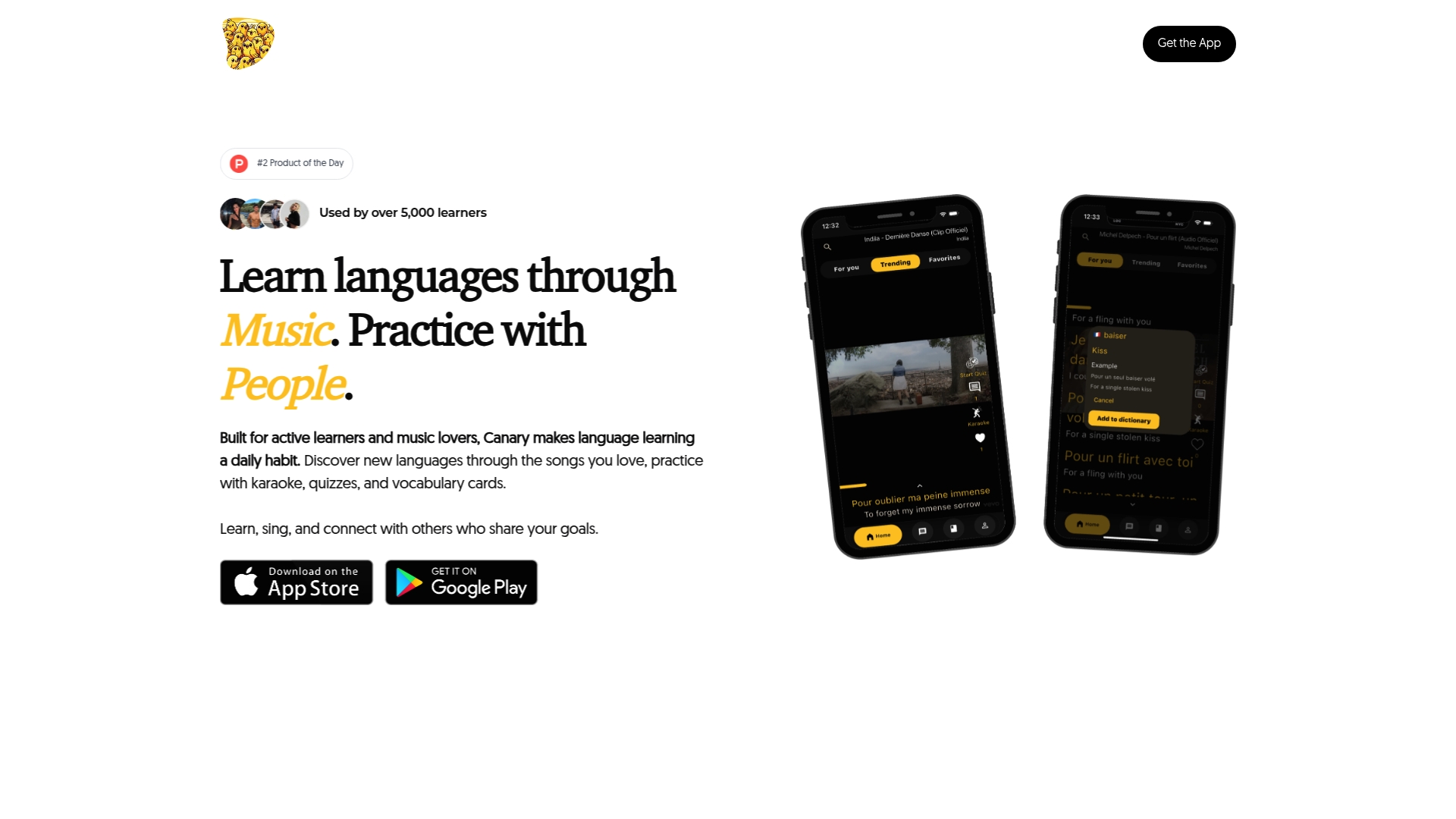
The social layer makes the biggest difference. Practicing with international learners and native speakers through Singwithcanary turns passive music exposure into the kind of active, communicative practice that actually drives acquisition. You’re not just listening. You’re engaging. Start learning languages with music today, or create your free account and begin building your immersion habit with something you’ll actually look forward to every day.
FAQ
What is the language immersion definition?
Language immersion is a learning method where the target language is used as the primary vehicle for all communication and instruction, not just the subject being studied. It prioritizes contextual, meaningful exposure over grammar-focused translation methods.
Does immersion require living in another country?
No. Active engagement creates immersion, not geographic location. Learners can build effective immersion through self-directed media, social interaction, music, and structured practice from anywhere.
What is the difference between immersion and total immersion?
Immersion refers broadly to using the target language as the primary medium of learning, while total immersion means 100% instruction in the target language, at least in early phases, with no reliance on the native language for classroom instruction.
How long does language immersion take to produce results?
Meaningful results typically appear within weeks when input is comprehensible and practice is daily. Deep fluency develops over months to years, which is why immersion programs span multiple grades or long-term self-directed commitments.
Can adults benefit from language immersion?
Absolutely. Adults bring motivation, context, and strategy to immersion that children lack. The acquisition mechanisms are the same, and adults can accelerate progress by deliberately seeking out comprehensible input and interactive language practice that children access naturally through school.