TL;DR:
- Music immersion involves actively engaging with songs in a target language to enhance vocabulary, pronunciation, and listening skills. It fosters stronger memory encoding through melody and rhythm, reduces language anxiety, and accelerates fluency when combined with reflection and practice; however, it works best alongside other language learning methods. Consistent, focused participation and social singing activities amplify its benefits, making it a vital foundation for effective language acquisition.
Music immersion is defined as the practice of learning a language by actively engaging with music in that language, using rhythm, melody, and repetition to accelerate vocabulary retention and pronunciation accuracy. Unlike passive background listening, true music immersion demands your full attention. A June 2026 study with 120 university students found that regular engagement with music in a target language improves vocabulary retention, pronunciation accuracy, and listening comprehension compared to traditional methods. That result is not a coincidence. It reflects how the human brain processes language when melody and meaning arrive together, creating memory pathways that grammar drills simply cannot replicate.
What is music immersion and why does it work for language learning?
Music immersion is the deliberate, repeated exposure to a target language through songs, singing, and lyric study, with the goal of internalizing pronunciation, vocabulary, and grammar patterns. The industry term for this approach is music-mediated language pedagogy, though music immersion captures the lived experience of the method more accurately for most learners.

The cognitive case for this approach is strong. Research published in May 2025 confirmed that students using music-integrated learning modules report higher pronunciation accuracy, motivation, and lower anxiety than control groups. The mechanism involves hippocampal encoding and dual coding theory. When you hear a word set to a melody, your brain stores it through two channels simultaneously: the auditory-musical channel and the linguistic channel. That double encoding makes recall significantly faster and more durable than reading a vocabulary list.
Rhythm also trains your ear to recognize phonological patterns. Every language has a natural stress and intonation rhythm, and music forces you to feel that rhythm before you consciously understand it. Spanish learners who sing along to reggaeton, for example, absorb the language’s characteristic stress patterns through repetition long before a textbook explains them. The same principle applies to tonal languages like Mandarin, where pitch is meaning.
The emotional dimension matters just as much as the cognitive one. Music supports emotional regulation and lowers anxiety, which is particularly significant for language learners who freeze up during speaking practice. Lower anxiety means more willingness to attempt pronunciation, make mistakes, and try again. That cycle of low-stakes repetition is exactly how fluency develops.
How to practice music immersion effectively
The difference between music immersion that produces results and music that simply plays in the background comes down to structure and active participation. Here is a practical sequence that language learners at any level can follow:
-
Choose songs at the right difficulty level. Songs with clear pronunciation, moderate tempo, and repetitive chorus structures work best for beginners. Too complex or fast songs hinder learning, while structured activities like cloze exercises enhance retention. Start with artists known for clear diction in your target language before moving to rapid-fire rap or heavily accented regional music.
-
Read the lyrics before you listen. Scan the full lyrics in the target language first. Note unfamiliar words, look them up, and mark where the stress falls. This primes your brain to hear what it would otherwise miss.
-
Follow along with lyrics during playback. Following along with lyrics and studying transcriptions reveals language architecture missed by ear alone. You will notice contractions, elisions, and connected speech patterns that no textbook teaches explicitly.
-
Sing along out loud. This is the step most learners skip, and it is the most important one. Singing forces your mouth to produce the sounds, not just recognize them. Repeat the same song across multiple sessions until the lyrics feel automatic.
-
Use cloze exercises for active recall. Print or copy the lyrics, blank out every fifth or tenth word, and fill in the gaps from memory after listening. This technique converts passive familiarity into active retrieval, which is the mechanism that locks vocabulary into long-term memory.
-
Reflect on what you learned. After each session, write two or three sentences using new vocabulary from the song. Connecting new words to your own thoughts accelerates transfer to real conversation.
Pro Tip: Active, focused music listening with singing yields stronger pronunciation breakthroughs than passive listening alone. Treat each song like a short lesson, not background noise.
A 2025 scoping review synthesizing a decade of research confirmed that music-mediated pedagogy delivered in brief, recurrent episodes is a low-cost, high-engagement approach that connects language content mastery with real proficiency gains. Short daily sessions beat long weekly ones every time.
How music immersion compares to other language learning methods
Every language learning method has a ceiling. Understanding where music immersion fits among the options helps you build a practice that covers all the bases.
| Method | Strengths | Limitations |
|---|---|---|
| Music immersion | Pronunciation, motivation, emotional engagement, vocabulary retention | Limited grammar instruction, requires active effort to be effective |
| Textbook study | Grammar structure, systematic vocabulary | Low engagement, minimal pronunciation training, anxiety-inducing for many learners |
| Conversation practice | Real-world fluency, listening comprehension | Requires a partner, high anxiety for beginners |
| Language apps (flashcard-based) | Vocabulary breadth, convenience | Weak pronunciation training, no contextual depth |
| Full cultural immersion | Fastest fluency gains, authentic exposure | Expensive, not accessible to most learners |
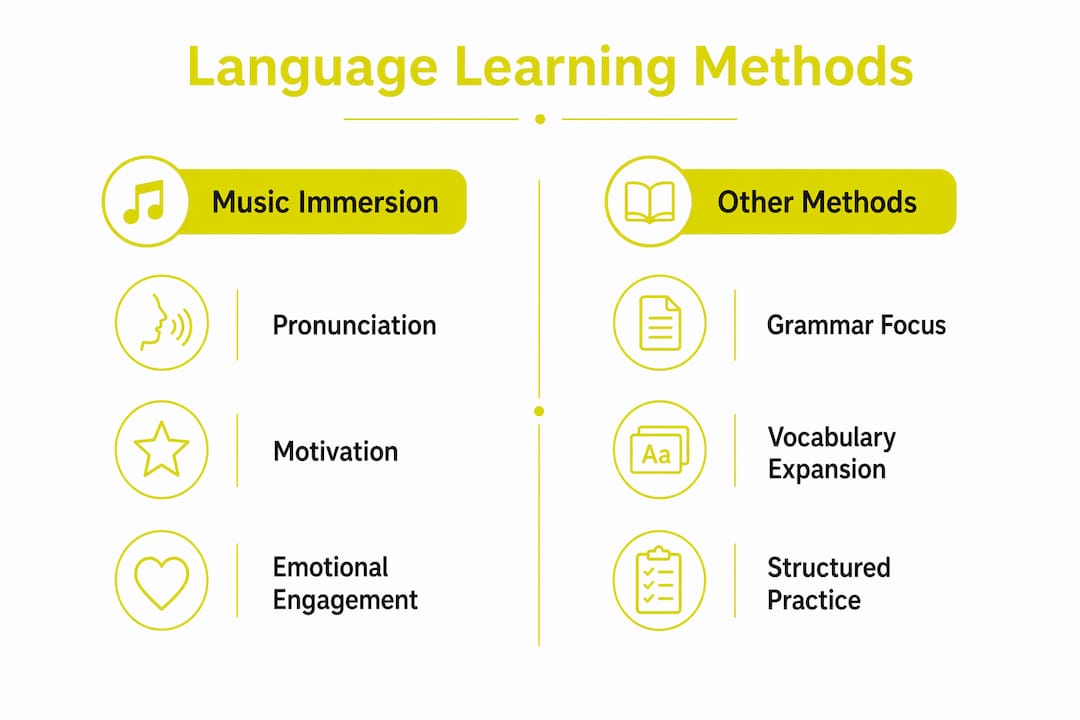
Music immersion occupies a unique position in this table. It delivers the emotional engagement of cultural immersion language learning without requiring you to relocate. It also addresses the anxiety problem that kills progress for millions of learners. When you are singing along to a song you love, the fear of sounding foolish disappears. That psychological shift is not trivial. It is the reason learners who use music-based methods tend to stick with their practice longer than those grinding through grammar exercises.
The limitations are real, though. Music immersion alone will not teach you how to construct complex sentences or navigate formal registers. The most effective learners combine it with at least one grammar-focused method and regular conversation practice. Think of music immersion as the foundation that makes everything else easier, not the entire structure.
The social dimension of group music activities adds another layer of benefit. Singing with others, whether in a class, a language exchange, or an online community, reduces the isolation that causes many self-study learners to quit. The social and motivational benefits of shared musical practice consistently appear in research on sustained language learning.
What role does singing play in language acquisition?
Singing is not just a fun add-on to language study. It is a cognitively distinct activity that activates language acquisition pathways in ways that speaking and reading do not.
The Singing-Oriented Language and Music Education framework, known as SOLME, provides the clearest research-backed explanation of why this is true. According to a comprehensive 2026 review, singing replicates early language acquisition processes by combining rhythm, pitch, and emotional engagement to build phonological awareness and pronunciation from the ground up. Children learn their first language partly through song, nursery rhymes, and rhythmic speech. Adult learners can access the same neural pathways deliberately.
Singing also functions as a multisensory activity. Your auditory system processes the melody and the words simultaneously. Your motor system controls breath, articulation, and pitch. Your emotional system responds to the music’s mood. That three-way engagement creates what researchers call a deeper encoding event, meaning the memory trace is stronger and more resistant to forgetting.
Here is what that means practically for language learners:
- Singing a phrase in a target language activates the same motor programs used in natural speech, which is why singers often have noticeably better accents than non-singing learners at the same study level.
- Repeated singing of the same song builds automaticity in pronunciation, the point where you produce sounds correctly without conscious effort.
- Emotional connection to a song increases the likelihood of spontaneous recall. Learners frequently report that words from songs they love surface naturally in conversation, while words from vocabulary lists do not.
- Group singing, such as karaoke or choir practice in a target language, adds social reinforcement that sustains motivation over months and years.
Pro Tip: Pick songs you genuinely enjoy, not songs chosen purely for linguistic simplicity. Emotional investment in the music is what drives the repeated exposure that produces lasting results.
The SOLME framework also emphasizes that singing is a hybrid skill combining vocal-motor control, emotion, precision, and attention. That combination makes it a natural connector between musicality and language in ways that no other single activity replicates.
Key takeaways
Music immersion works because active singing and lyric study create dual-encoded memory traces that passive listening and textbook study cannot replicate, making it the most emotionally engaging and neurologically efficient method for pronunciation and vocabulary acquisition.
| Point | Details |
|---|---|
| Music immersion definition | Active engagement with songs in a target language to build vocabulary, pronunciation, and listening skills. |
| Active over passive | Singing along and studying lyrics produces stronger results than background listening alone. |
| Song selection matters | Choose songs with clear diction and moderate tempo before advancing to complex or fast material. |
| Combine with other methods | Music immersion builds motivation and pronunciation but needs grammar study and conversation practice to complete fluency. |
| Singing activates acquisition | The SOLME framework confirms singing replicates early language learning processes through rhythm, pitch, and emotional engagement. |
Why I think most learners underestimate music immersion
Most language learners treat music as a reward after the real studying is done. That instinct is exactly backward. In my experience, the learners who make the fastest pronunciation gains are the ones who treat song-based practice as the core of their routine, not the dessert.
The research on immersive learning makes a point that I find genuinely underappreciated: immersion requires protecting time and space for exploration, not just exposure. That means sitting with a song long enough to feel it, not just playing it once and moving on. Most learners give a song two or three listens and conclude they have “done” it. Real immersion means returning to the same material across days and weeks until the language inside it becomes automatic.
The other mistake I see constantly is treating music immersion as a solo activity. The social dimension is where the real confidence gains happen. Singing with other learners, even badly, removes the self-consciousness that makes pronunciation practice feel high-stakes. Once you have laughed through a karaoke session in your target language, speaking to a native speaker feels far less terrifying.
My honest advice: pick three songs you love in your target language, commit to them for a full month, and measure your pronunciation against a recording of yourself from day one. The gap will surprise you.
— Ben
Start learning languages through music with Singwithcanary
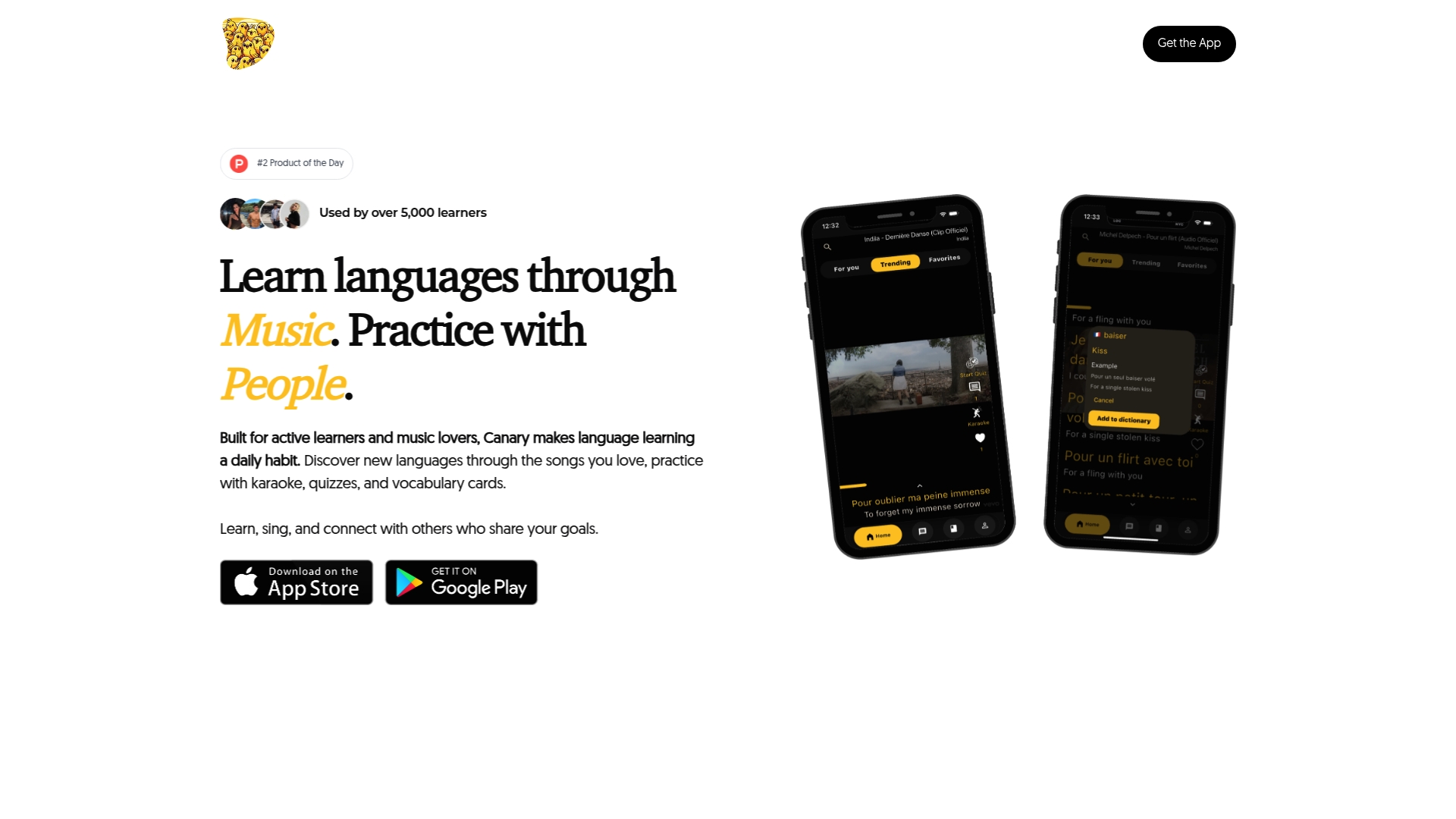
Singwithcanary is built specifically for learners who want to put music immersion into daily practice. The platform combines curated song libraries, interactive lyric quizzes, vocabulary cards drawn directly from song lyrics, and karaoke-style singing practice, all designed around the techniques covered in this article. You can learn languages with music at your own pace while connecting with other learners around the world who share your songs and your goals. If you want a structured way to turn the music immersion techniques above into a daily habit, Singwithcanary gives you the tools and the community to make it stick. Explore the platform and start your first song-based lesson today.
FAQ
What is the music immersion definition in simple terms?
Music immersion is the practice of learning a language by actively engaging with songs in that language, using melody, rhythm, and repetition to build vocabulary and pronunciation naturally.
Is music immersion effective for adult language learners?
Yes. A 2026 study with 120 university students found that music-integrated learning improves vocabulary retention, pronunciation accuracy, and listening comprehension compared to traditional study methods.
How is music immersion different from just listening to foreign music?
Passive listening builds familiarity, but music immersion requires active participation: reading lyrics, singing along, completing cloze exercises, and reflecting on new vocabulary to produce measurable language gains.
What are the best music immersion techniques for pronunciation?
Singing along with lyrics, following transcriptions to catch connected speech patterns, and repeating the same song across multiple sessions are the most effective techniques for improving pronunciation accuracy.
Can music immersion help with language anxiety?
Research confirms that music supports emotional regulation and lowers anxiety, making learners more willing to attempt pronunciation and sustain practice over time, particularly in group or social singing settings.