TL;DR:
- Music-infused learning uses deliberate musical activities to actively improve language skills.
- Passive background music can hinder, not help, language acquisition due to divided attention.
- Structured, goal-oriented musical practice enhances pronunciation, vocabulary, memory, and fluency.
Most people stick a playlist on in the background and call it “learning with music.” That’s not it. Music-infused learning, as defined by recent educational research, is a structured approach where songs, lyrics, rhythm, singing, and musical performance are deliberately used as instructional tools to build real language skills. The difference between background and instruction is enormous, and understanding it could completely change how fast you progress in your target language.
Table of Contents
- Defining music-infused learning
- Music as background versus music as instruction
- How music enhances language acquisition: Mechanisms at work
- Applying music-infused learning: Tips and best practices
- A fresh perspective: What most articles miss about music and learning
- Level up your language skills with music
- Frequently asked questions
Key Takeaways
| Point | Details |
|---|---|
| Intentional design matters | Music boosts language gains only when used as structured, goal-driven instruction, not passive background. |
| Mechanism-targeted activities | The best results come from music tasks that focus on affect, prosody, or memory, supported by assessment. |
| Limited direct transfer | Music training alone boosts rhythm more than literacy, highlighting the need for targeted approaches. |
| Avoid common pitfalls | Simply listening to music or choosing random songs rarely supports language growth—deliberate methods are key. |
| Practical strategies work | Routine, engaging, and social music-based practices are most effective for sustained language learning. |
Defining music-infused learning
Music has been floating around language classrooms for decades, usually as a reward or a break from “real” learning. That framing undersells it badly. When used with intention and structure, music becomes one of the most powerful instructional channels available to language learners.
So what exactly is music-infused learning? According to researchers, music-infused learning is “an approach where music, songs, lyrics, rhythm, singing, and often music-based performance, is deliberately used as instructional input or practice to teach or reinforce language skills and other academic targets.” That word deliberately carries all the weight here. It separates a teacher who throws on a Spanish pop song at the end of class from a learner who actively dissects lyrics, practices pronunciation by singing along, and tracks new vocabulary pulled from a chorus.

The role of music in language learning covers three main mechanisms that make this approach work. First, there is affective regulation, which means music lowers anxiety and boosts motivation so learners stay engaged longer. Second, there is prosodic and rhythmic entrainment, where the melody and beat of a song help learners absorb the natural rhythm, stress patterns, and intonation of a language. Third, there is memory and retrieval, because information tied to melody is often easier to recall than information studied as plain text.
| Feature | Music-infused learning | Passive music listening |
|---|---|---|
| Design | Structured, goal-driven | Unplanned, incidental |
| Learner role | Active participant | Passive consumer |
| Language focus | Specific skills targeted | General exposure only |
| Outcome measurement | Tracked and assessed | Rarely evaluated |
| Example activity | Lyric gap-fills, singing drills | Background playlist |
Not every musical activity delivers the same result. Singing karaoke style through a song you already know is different from studying an unfamiliar song line by line, looking up new words, and then performing it to practice pronunciation. Both are fun, but only one is structured enough to drive measurable progress.
“Music-infused learning is an approach where music, songs, lyrics, rhythm, singing, and often music-based performance, is deliberately used as instructional input or practice to teach or reinforce language skills and other academic targets.” — Frontiers in Education, 2026
Music as background versus music as instruction
Walk into any library or coffee shop and you will see language learners with headphones on, music playing, textbook open. They feel productive. But the music is almost certainly working against them.

Research makes a sharp distinction between using music incidentally, as background audio, versus using it as an instructional channel with measurable learning objectives and follow-up assessment. When music plays in the background while you study vocabulary or grammar, it competes for the same verbal working memory you need to process new words. The result is divided attention, which typically slows learning rather than accelerating it.
Here is what changes when you flip from background to instruction:
- You set a specific goal. Instead of “I’ll study Spanish for an hour with music on,” you say “I’ll learn five new adjectives from this song and practice their pronunciation.”
- You interact with the music. You pause, rewind, look up words, and repeat phrases rather than letting it wash over you.
- You measure something. After the session, you test yourself on the vocabulary or record yourself singing the target phrases.
- You build on each session. The songs and vocabulary stack, creating a growing, personalized system rather than scattered exposure.
| Approach | Typical outcome | Why it works (or doesn’t) |
|---|---|---|
| Background music while studying | Minimal language gains, possible distraction | Competes for working memory |
| Casual song enjoyment | Cultural exposure, some vocabulary pickup | No structured retrieval practice |
| Instructional music activity | Targeted vocabulary, pronunciation, prosody gains | Deliberate, goal-linked, assessed |
| Song-based social practice | Vocabulary, fluency, and motivation boost | Active + social + emotional engagement |
The educational benefits of music in language learning are real, but they show up consistently only when the activity is designed around a language goal. Similarly, the song-based language learning benefits that researchers document, better pronunciation, stronger vocabulary retention, more natural intonation, come from active engagement with lyrics, not from ambient listening.
Pro Tip: Before starting any music-based study session, write down one specific language goal. It could be “learn the three verb tenses used in this chorus” or “master the pronunciation of these five words.” A written goal keeps you in instructional mode, not passive listening mode.
How music enhances language acquisition: Mechanisms at work
Understanding why music works helps you design better practice sessions. There is not one single mechanism at play here. There are several, and they each target a different aspect of language learning.
Here are the four core mechanisms of music-based language learning:
-
Affective regulation. Music triggers emotional responses that reduce anxiety and increase motivation. For language learners, this matters enormously because fear of making mistakes is one of the biggest barriers to progress. A familiar song feels safe, which encourages more attempts and longer practice sessions.
-
Prosodic entrainment. Every language has its own rhythm, stress, and melody. Songs exaggerate these patterns in ways that make them easier to absorb. When you sing in your target language, you practice the music of that language without even realizing it, training your ear and your mouth simultaneously.
-
Memory and retrieval. This is the big one. Melody acts as a kind of scaffold for memory. You already know this from experience: you can probably recall the words to dozens of songs you have not heard in years, while struggling to remember vocabulary you studied last week. Expanding vocabulary with songs exploits this natural memory hook deliberately.
-
Chunked language input. Songs present language in short, repeated chunks. Repeated exposure to the same phrase in a musical context builds fluency faster than reading the same phrase in a list.
However, it is important to be honest about the limits here. Empirical work suggests that music and rhythm can correlate with literacy outcomes, but causal transfer, meaning music gains producing literacy gains, may be limited depending on intervention design and what is actually trained. In plain language: improving your sense of rhythm through music does not automatically make you better at reading or speaking a new language. The intervention has to directly target the skill you want to improve.
This is why a step-by-step approach to language learning with music matters more than just “listening to more music.” If your goal is better pronunciation, your musical activities should explicitly practice pronunciation. If your goal is vocabulary, your activities should require you to look up, use, and test new words from the songs you study.
Statistical callout: Quasi-experimental research on rhythm and literacy shows that children who received rhythm-focused music training improved their rhythm skills significantly, but these gains did not automatically transfer to reading fluency without additional structured literacy instruction. The mechanism must be matched to the target outcome.
Applying music-infused learning: Tips and best practices
Theory is useful, but you are here because you want to actually get better at a language. Here is how to put these ideas into daily practice.
Match your musical activities to specific goals:
- For pronunciation: Choose a song with clear, slow enunciation. Sing along, record yourself, compare your version to the original. Focus on vowel sounds and word stress.
- For vocabulary: Pick songs with rich, everyday vocabulary. Write out the lyrics, underline unknown words, look them up, and create flashcards from your findings. Then sing the song until those words feel natural.
- For listening comprehension: Listen to a song without reading the lyrics first. Try to transcribe what you hear. Then check your transcription against the actual lyrics. The gaps you missed are your weakest listening points.
- For grammar: Find songs that use a specific tense or structure you are studying. Hearing a grammar rule sung in context cements it far better than drilling it in a workbook.
Build repetition into your routine without boredom. The most effective way to use songs is to study the same track for a week rather than cycling through different songs daily. Deep familiarity with one song builds more language skill than surface exposure to twenty. Rotate songs weekly and revisit favorites monthly.
Track your progress, not just your time. It is easy to feel like you are learning because you enjoyed a song. But learning requires measurement. After each session, quiz yourself on the vocabulary you encountered. Record yourself speaking or singing and listen back. Notice whether your pronunciation is improving.
Avoid the most common trap: letting music drift back into the background. This happens gradually. You start with focused study, then you start doing other things while the song plays, and within a few sessions you are right back to passive listening. Research design principles consistently emphasize mechanism-first design: music should target affect, prosody, or memory in a structured way, with transfer measurement planned in advance.
Use social practice to deepen engagement. Singing with other learners, sharing playlists, or discussing lyrics in your target language adds accountability and joy in equal measure. Use your language learning with music guide as a reference for building a structured weekly routine.
Pro Tip: Build a dedicated language-learning playlist using songs chosen for their clear pronunciation and vocabulary richness in your target language, not just songs you personally enjoy. A song might be your favorite in English but useless for learning French if the lyrics are slurred or too fast. Let the learning goal drive your music choices.
A fresh perspective: What most articles miss about music and learning
Here is the uncomfortable truth that most “music and language” content skips: music is not magic. Putting on foreign-language songs will not make you fluent any more than watching cooking shows will make you a chef. The structure matters far more than the music itself.
What makes music-infused learning genuinely powerful is not the music. It is the emotional investment that music creates, and what you do with that investment. When a song moves you, you replay it. You look up the words. You try to sing along. You show it to someone else. Every one of those actions is a learning behavior, and music is the trigger that makes you do them voluntarily, even joyfully.
The benefits of song-based language learning are most visible in learners who build community around their musical practice. Learners who sing with others, share songs in language exchange groups, or participate in organized song challenges tend to stick with their language goals far longer than learners who study alone with headphones. The social dimension is not a bonus feature. It is often the deciding factor between someone who quits after three months and someone who reaches conversational fluency.
The most effective music-based learners we have seen treat songs like texts to be studied, not just sounds to be enjoyed. They are curious. They want to know why a lyric uses one word instead of another. They notice when a singer pronounces something differently from what they expected. That intellectual curiosity, sparked by emotional engagement with the music, is what drives real, lasting progress.
Level up your language skills with music
If you have been nodding along to these ideas and wondering how to actually put them into practice every day, Canary is built exactly for this. The platform brings together music-infused learning, social practice, and structured tools in one place, so you are not piecing together a method on your own.
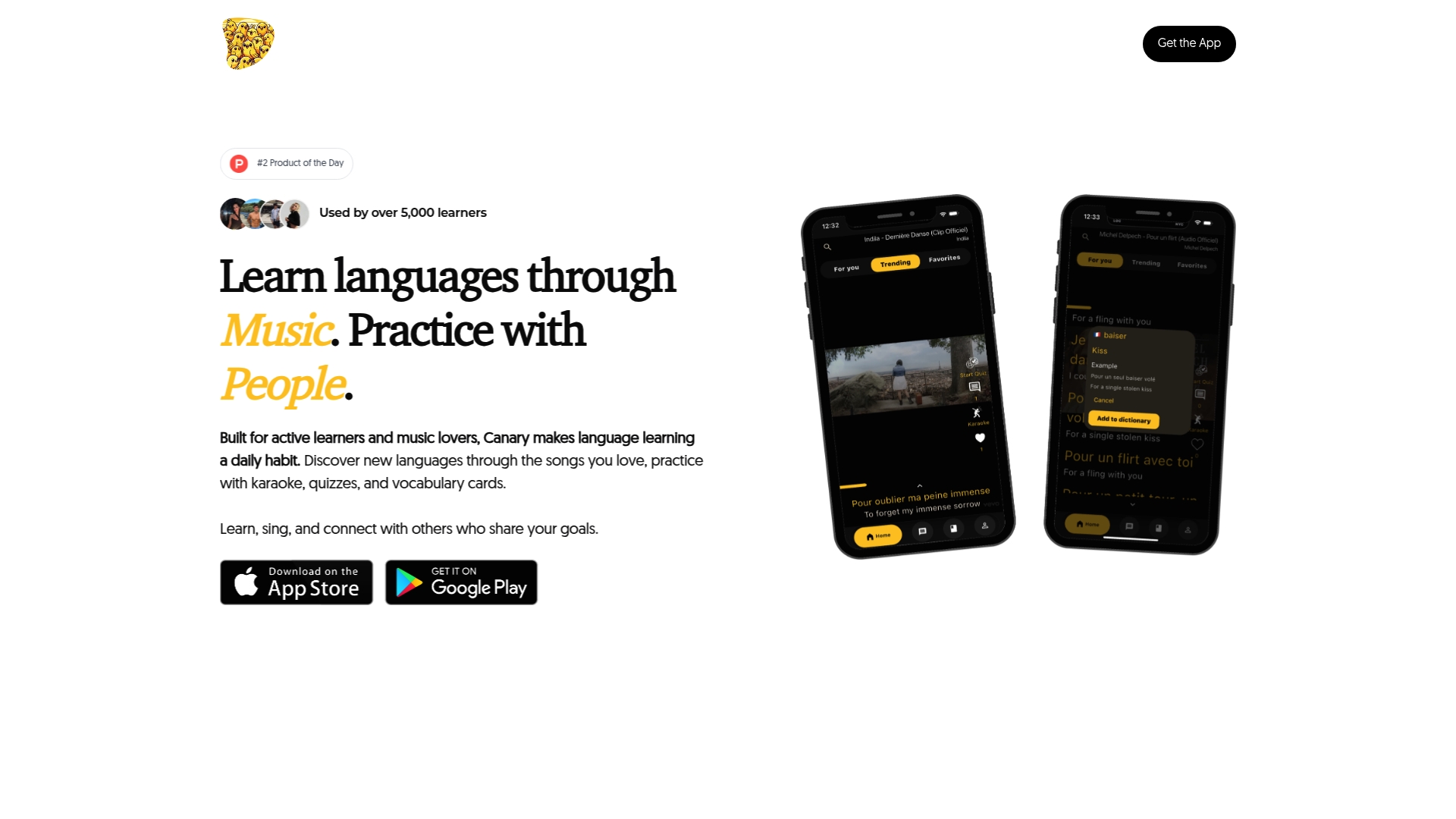
Canary lets you learn languages with music through interactive karaoke, vocabulary cards pulled directly from lyrics, and pronunciation practice built into every song session. The community features mean you are never studying alone, and the weekly song of the week challenge gives you a shared goal with other learners worldwide. For a deeper look at the research behind the approach, explore the full guide to educational benefits of music and language and see exactly how each feature maps to a learning outcome.
Frequently asked questions
How is music-infused learning different from listening to music while studying?
Music-infused learning involves deliberate instructional design with specific language goals, while background listening is passive and rarely produces consistent language gains.
Can music, on its own, improve literacy and language proficiency?
Music activities can strengthen rhythm skills and motivation, but causal transfer to literacy requires carefully structured interventions tied directly to your language goals.
What are common mistakes with music-based language learning?
The biggest mistake is using music without explicit goals, which turns instructional practice into background noise and reduces its effectiveness significantly.
Are there specific types of music or activities best for language learning?
Singing, lyric analysis, and pronunciation drills are the most effective because they directly target language skills like prosody, vocabulary, and memory retrieval in structured, measurable ways.