TL;DR:
- Social language practice involves deliberately training pragmatic and sociopragmatic skills for effective communication across diverse social contexts. It emphasizes meaningful interaction, nonverbal cues, and cultural norms, beyond just vocabulary and grammar mastery. Engaging consistently in real conversations with feedback is essential for developing fluency and cultural competence.
Most people assume language learning is solved once you know enough words and grammar rules. That assumption is exactly why fluent speakers still get blank stares or awkward silences in real conversations. What is social language practice? It is the deliberate work of learning to use language appropriately across different social situations — not just correctly, but fittingly. It covers how you open a conversation, respond to humor, soften a request, or pick up on unspoken cues. The difference between knowing a language and communicating in it comes down to this skill.
Key takeaways
| Point | Details |
|---|---|
| Beyond grammar and vocabulary | Social language practice targets the when, how, and why of language use, not just the what. |
| Pragmatic competence matters | Learning linguistic forms and when they are socially appropriate is the core of communicating effectively. |
| Interaction beats passive exposure | Meaningful conversational turns with real feedback produce growth; passive listening alone does not. |
| Community and tech both work | Group programs, virtual exchanges, and music-driven platforms all provide authentic social practice opportunities. |
| Measure progress concretely | Track observable behaviors like turn-taking, topic maintenance, and contextual appropriateness to stay on track. |
What social language practice actually means
The term “social language practice” describes something that researchers and speech-language pathologists typically call pragmatic competence or social communication. Those two phrases are the industry-standard terms, and understanding them makes the whole concept sharper.
Social communication is defined as multimodal and dependent on social cognition, meaning it covers verbal language, nonverbal signals, written exchanges, and gestural cues working together. When you practice social language, you are not just rehearsing phrases. You are training your ability to read a room, adjust your tone, recognize indirect meaning, and respond in ways that feel natural to the people around you.
Researchers break pragmatic competence into two specific layers:
- Pragmalinguistic knowledge covers the relationship between linguistic forms and their functions. For example, knowing that “Could you pass the salt?” is a request, not a question about physical ability.
- Sociopragmatic knowledge covers whether a particular form is appropriate given the context, your relationship with the listener, and the social setting. Asking a close friend “Can you just send that file?” lands differently than asking your boss the same thing.
These two layers interact constantly. Pragmatic competence involves both knowing which forms exist and understanding when each form fits the social situation.
Social language practice also includes multimodal communication, which means nonverbal cues like eye contact, facial expression, and body posture are part of the practice, not optional extras. A confident sentence delivered while looking at the floor sends a contradictory message. Practicing social language means training all of these channels together.
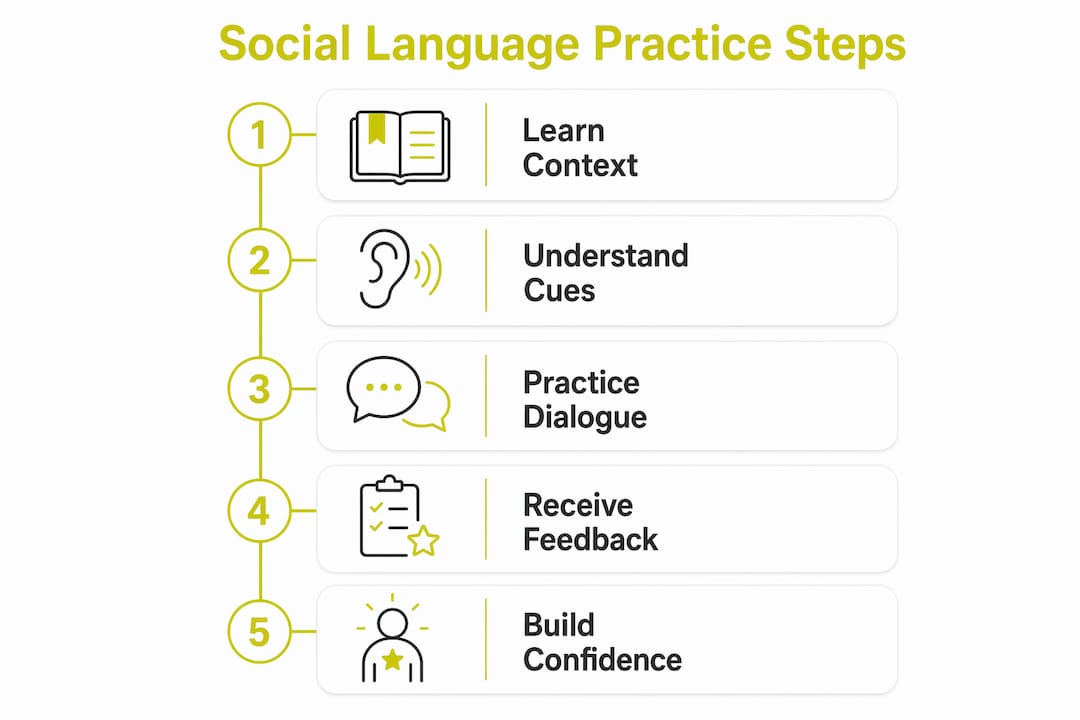

Common examples of social language in action include exchanging greetings appropriately (formal versus casual), making requests without sounding demanding, taking turns in conversation without interrupting, and interpreting sarcasm or humor without taking it literally.
Pro Tip: When you study a new phrase, always note the social context it belongs to. Write down who is speaking, to whom, and in what setting. That context is half the information you actually need.
Tools and methods for interactive practice
Understanding what social language practice is only gets you so far. The real question is how to actually do it. The good news is that several proven approaches exist, ranging from structured group programs to technology-driven exchanges.
-
Community group programs. Structured programs like the Social Climbers program at the University of Iowa match participants by age and skill level for guided social language sessions. Clinician support combined with peer interaction creates repeated cycles of real conversation, feedback, and repair. This structured repetition is what drives genuine skill acquisition rather than occasional exposure.
-
Virtual exchanges and telecollaboration. Connecting learners with native or fluent speakers through video calls or messaging produces measurable results. A 2025 study found that virtual exchanges improve sociolinguistic competence in second-language learners, including nuanced outcomes like correctly using regional pronoun variations. Authentic interaction with native speakers closes the gap between classroom knowledge and real-world social norms in ways that textbooks cannot replicate.
-
Technology-enhanced learning tools. Computer-mediated communication tools, including synchronous chats, interactive apps, and social platforms, support autonomous pragmatic learning by giving learners flexible practice time and personalized feedback. The preparation time that asynchronous messaging allows is particularly valuable. It lets you think carefully about how to phrase something before sending, which builds sociopragmatic awareness over time.
-
Music-driven social platforms. Practicing language through song lyrics trains ear recognition for natural speech rhythm, pronunciation, and culturally embedded phrases. Platforms that pair this with community interaction — like practicing languages socially with music — give learners authentic social context alongside enjoyable repetition.
-
Conversation partner exchanges. Finding a regular conversation partner, especially a native speaker, remains one of the highest-return activities for social language development. For this to work, the practice needs structure. Aim for specific scenarios, ask for honest feedback, and track which social situations still feel awkward.
One challenge specific to online practice is that learners sometimes get exposure without real uptake. You watch videos, you listen to podcasts, but you never produce language and receive a reaction. That gap is where growth stalls. Meaningful social interaction for language learning requires two-way exchange, not passive consumption.
Pro Tip: During every practice session, aim to have at least three full conversational turns where you initiate, respond, and follow up. Brief exchanges do not build social language skills the way sustained back-and-forth does.
Why social language practice matters for real communication
Grammar mastery does not prevent communication breakdowns. It prevents incorrect sentences. Those are not the same problem. The importance of social language becomes clear the moment you watch a technically fluent speaker say exactly the wrong thing at exactly the wrong time.
“Learners who receive explicit pragmatic instruction consistently outperform those who rely on immersion alone, even at advanced proficiency levels.” (A Systematic Review of Technology Integration in Developing L2 Pragmatic Competence)
This is one of the most practically significant findings in language acquisition research. Immersion is valuable, but without targeted social practice, advanced learners still make sociopragmatic errors. They might be too direct in cultures that value indirectness, or too formal with people who expect casual warmth. These missteps do not come from ignorance of vocabulary. They come from gaps in sociopragmatic knowledge.
The benefits of social language practice extend across several dimensions. First, it improves your ability to understand indirect language, including politeness strategies, humor, irony, and implied meaning. These are things a dictionary will never teach you. Second, it builds cultural competence. Language does not exist outside of culture, and social practice is where cultural norms become lived experience rather than abstract knowledge.
Third, and perhaps most importantly, it builds confidence. Learners who practice in real social settings report reduced anxiety in conversations, faster processing of social cues, and greater comfort adapting their language to different audiences. These measurable outcomes include improved turn-taking, better topic maintenance, and greater contextual appropriateness. All of them are trainable with the right practice.
The risk of skipping social practice is what researchers call exposure without uptake. You absorb a language passively through media and environment but never get the feedback loops that signal whether your usage actually lands. Meaningful interaction overcomes this by creating moments where miscommunication surfaces and gets corrected in real time.
How to practice social language effectively
Knowing you need social language practice and knowing how to do it well are different things. Here is what actually works, and what to stop wasting time on.
-
Prioritize speaking with real people over solo study. Reading about politeness strategies is useful. Attempting one in a live conversation and getting a reaction is where learning actually sticks. Seek out native or fluent speakers in meaningful contexts, not just formal lessons. Informal settings like community groups, language exchanges, and even music-based platforms create the social pressure that activates your pragmatic skills.
-
Practice across multiple communication modes. Vocal tone, facial expressions, and physical gestures carry social meaning. If you only practice written exchanges, you are training half the skill. Try video calls over text-only chats when possible, and pay attention to what your face and posture are doing.
-
Use structured feedback actively. Passive conversation does not automatically produce improvement. Ask your conversation partner to flag moments where your phrasing felt off, too formal, too blunt, or confusing. Then reflect on the context and revise your approach for next time. This reflection loop is what separates deliberate practice from just talking.
-
Do not skip conversational repair. When a misunderstanding happens, work through it. Ask for clarification. Rephrase. This back-and-forth is some of the richest social language practice available, yet most learners try to paper over awkward moments and move on quickly.
-
Commit to sustained, repeated sessions. Matching participants by skill level and maintaining sustained session lengths are critical factors for success in group social language programs. The same principle applies to individual practice. One session a week will not build social fluency. Consistent, shorter sessions spread across the week produce faster results.
-
Use technology as a bridge, not a replacement. Online platforms and apps provide flexibility and access to authentic language communities. Language socialization through digital communities develops sociopragmatic awareness in ways that purely structured drills cannot. Use them to supplement, not replace, real human interaction.
My take on social language practice
I have spent years watching people invest enormous effort into language learning and still feel stuck the moment a real conversation starts. The pattern is almost always the same. They mastered the grammar. They expanded the vocabulary. They skipped the social practice.
What I have learned is that sociopragmatics is not a soft skill bolted onto language learning. It is the whole point. You are not trying to recite sentences. You are trying to connect with people, persuade them, amuse them, ask them for things, and understand what they actually mean rather than what they literally said. None of that happens through grammar drills.
The rise of virtual exchanges and community-driven platforms has genuinely changed access here. In the past, authentic social interaction with native speakers required travel or expensive programs. Now a motivated learner can find a conversation partner, join an online community, or practice in real-time through a music-driven app from anywhere in the world. That access is remarkable, but access alone does nothing. You have to show up, produce language, take your lumps when something lands wrong, and go again.
The tips for practicing with native speakers that actually help are not the obvious ones. They are about creating enough psychological safety to make mistakes and enough structure to learn from them. That combination is exactly what good community-based practice provides.
My honest advice: treat social language practice as the core of your learning plan, not the advanced module you will get to eventually.
— Ben
Take your social practice further with Singwithcanary
If you are ready to move beyond passive study and into real social language practice, Singwithcanary offers a path that does not feel like homework.
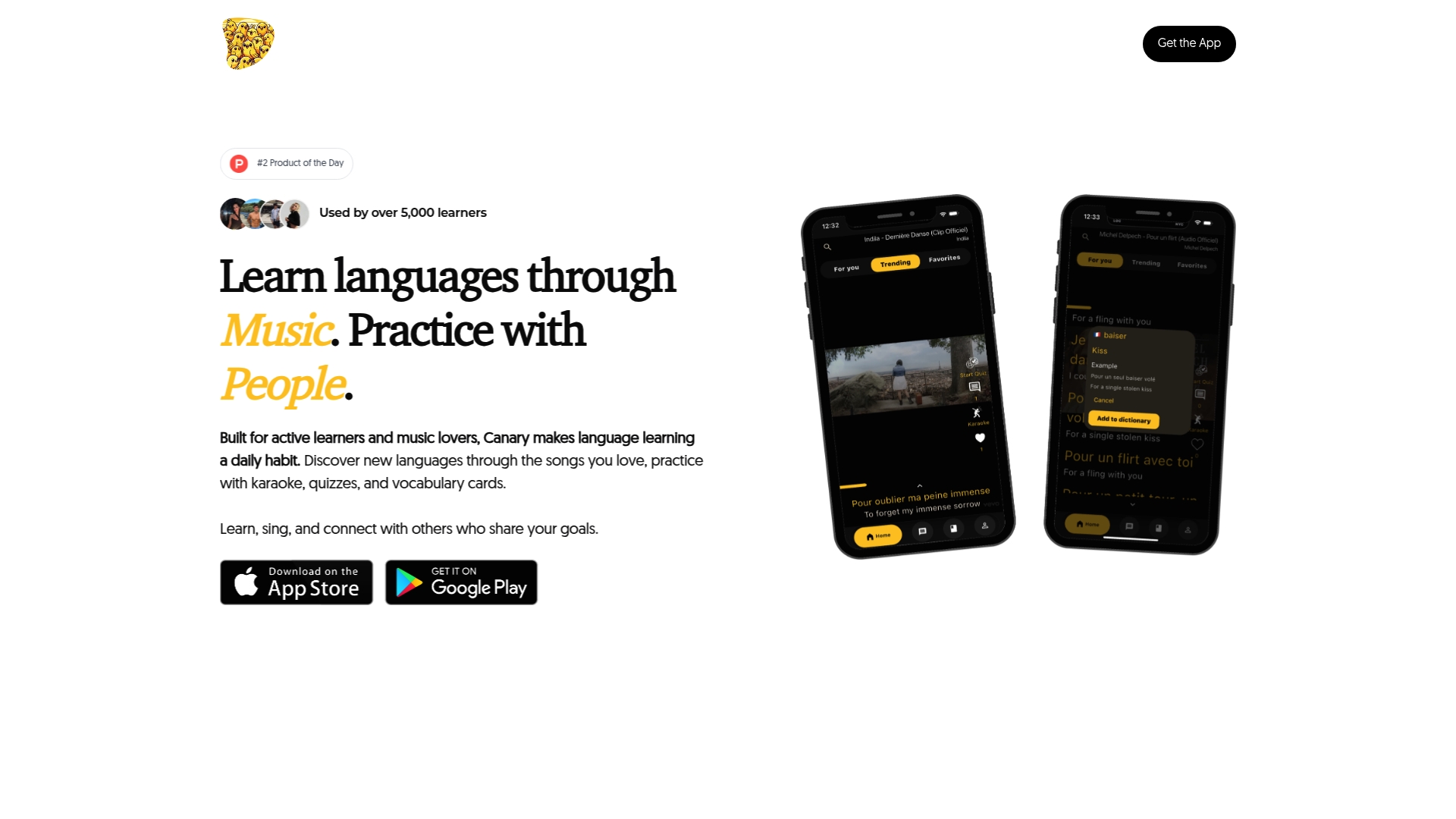
Singwithcanary combines song-based learning with a community of international learners and native speakers. Features like karaoke, vocabulary cards, and pronunciation quizzes train language in context, while the social layer connects you with real people for the kind of back-and-forth exchange that builds pragmatic competence. It is specifically built for learners who want to develop confidence in real-world conversations, not just pass a test.
If you want to explore apps for practicing with natives or jump straight into the Singwithcanary platform at singwithcanary.com, both are worth your time. Social language skills grow fastest when practice is consistent, enjoyable, and connected to real human interaction. Singwithcanary is built around exactly that combination.
FAQ
What is social language practice?
Social language practice is the deliberate training of pragmatic and sociopragmatic competence. It means learning not just what to say, but how, when, and with whom to say it across different social contexts.
How is social language practice different from regular language learning?
Regular language study focuses on vocabulary and grammar rules. Social language practice focuses on communication appropriateness, including tone, indirect meaning, cultural norms, and nonverbal cues.
What are the main benefits of social language practice?
The key benefits include improved real-world communication, stronger cultural competence, better understanding of humor and indirect language, and greater confidence in spontaneous conversation.
How do virtual exchanges help with social language skills?
Virtual exchanges expose learners to authentic social norms used by native speakers. Research shows they measurably improve sociolinguistic competence, including correct use of contextually appropriate language in real interactions.
What is the biggest mistake people make when practicing social language?
The biggest mistake is passive exposure without active production. Watching and listening without generating language and receiving feedback creates “exposure without uptake,” which produces minimal pragmatic growth.