TL;DR:
- Song-based vocabulary learning involves acquiring words through repeated exposure to meaningful song lyrics, engaging both emotional and rhythmic contexts. Research shows that this method enhances long-term retention better than traditional memorization by activating multiple neural pathways and lowering psychological barriers. Effective activities include selecting clear, relevant songs, and employing structured tasks like gap-fills, annotations, and production exercises to reinforce vocabulary.
Song-based vocabulary is the process of acquiring and practicing new words through repeated, meaningful exposure to language embedded in song lyrics. Unlike flashcard drills or grammar tables, this method treats music as a delivery system for incidental vocabulary learning, where words stick because they appear in emotional, rhythmic, and memorable contexts. Research in second-language acquisition increasingly validates what music lovers have always sensed: songs teach language in ways that textbooks simply cannot replicate. Platforms like Singwithcanary have built entire learning ecosystems around this insight, combining lyric-based activities with social practice to accelerate vocabulary growth.
What is song-based vocabulary and how does it work?
Song-based vocabulary is defined as building and practicing language knowledge through the meaningful, repeated contexts that song lyrics provide, rather than through isolated word lists or rote memorization. The term sits within the broader field of song-based language learning, which encompasses pronunciation, grammar, and cultural understanding alongside vocabulary. When researchers and educators use the phrase “music vocabulary” or “song vocabulary learning,” they are pointing to the same core mechanism: words absorbed through music carry stronger memory traces than words studied in silence.

The reason this works comes down to how the brain processes music differently from plain text. Songs activate auditory memory, emotional response, and semantic processing simultaneously. A word heard in a chorus you love gets encoded across multiple neural pathways at once. That multi-channel encoding is precisely what makes vocabulary gains from songs persist long after a single study session ends.
Three features of songs make them uniquely effective for vocabulary acquisition. First, repetition is built into the structure. A chorus repeats three or four times per song, giving you spaced reinforcement without any deliberate effort. Second, lyrics provide context. You rarely encounter a new word in isolation; you encounter it surrounded by emotion, story, and melody. Third, the affective dimension lowers what linguists call the “affective filter,” the psychological barrier that slows learning when anxiety is high. Music reduces that barrier, making new vocabulary more accessible.
How does song-based vocabulary support language learning?
The cognitive case for song-based vocabulary rests on dual-coding theory, developed by psychologist Allan Paivio. Dual-coding holds that information processed through both verbal and non-verbal channels (in this case, language and melody) is retained more reliably than information processed through one channel alone. Songs deliver vocabulary through sound, rhythm, and semantic meaning at the same time, creating exactly the kind of dual-coded memory trace that survives long-term.
Integrating music in language instruction produces greater vocabulary and pronunciation gains compared to traditional instruction, with learners also reporting higher motivation. That motivational lift matters more than it might seem. Motivated learners practice more, notice more, and return to the material more often. A song you enjoy is a resource you will voluntarily revisit dozens of times, generating the kind of spaced repetition that memory science consistently identifies as the most effective retention strategy.
“Songs work for vocabulary learning not just because they entertain, but because meanings in lyrics engage cognitive and affective learning mechanisms simultaneously.” — Cognitive and affective dimensions of learning with music
The affective filter effect is equally significant. Traditional vocabulary study can feel mechanical and anxiety-inducing, especially for adult learners. Songs reframe the experience as pleasure rather than performance. When you are singing along to a track you genuinely like, you are not monitoring yourself for errors. That relaxed state is precisely when incidental acquisition happens most naturally.
Key mechanisms that explain song-based vocabulary effectiveness:
- Auditory memory: Melody acts as a retrieval cue, making it easier to recall words heard in a song than words read from a list.
- Emotional encoding: Words tied to emotional experiences are stored more durably in long-term memory.
- Contextual meaning: Lyrics place vocabulary inside a narrative or feeling, giving words usage context that a dictionary definition cannot provide.
- Spaced repetition through structure: Choruses and repeated hooks deliver the same vocabulary multiple times per listening session without requiring deliberate review.
What research evidence supports song-based vocabulary learning?
The empirical record on song-based vocabulary learning has grown substantially in the past decade. An experiment with 114 Chinese college students demonstrated measurable vocabulary improvements after multiple exposures to English songs, with gains still detectable after four weeks. That four-week persistence is significant because it suggests the learning is moving into long-term memory rather than fading after a single session.
EFL learners studying with Taylor Swift’s Opalite reported that meaningful lyric contexts made vocabulary feel natural and memorable rather than arbitrary. Semi-structured interviews with those learners pointed to two specific factors: the repetition built into the song’s structure and the gap-fill activities that required active engagement with the lyrics. Passive listening alone produced weaker results than listening paired with structured tasks.
The table below summarizes key findings from the research base:
| Study focus | Method | Key finding |
|---|---|---|
| Vocabulary retention in EFL learners | Repeated song listening, 114 students | Gains persisted after 4 weeks of follow-up testing |
| Motivation and pronunciation | Music group vs. control group | Music group showed higher vocabulary gains and lower anxiety |
| Learner perceptions of song-based learning | Semi-structured interviews, Opalite lyrics | Repetition and gap-fill tasks rated most effective |
| Active vs. passive listening | Structured tasks vs. unguided listening | Structured tasks produced significantly stronger vocabulary acquisition |
Compared to rote memorization, song-based learning wins on retention, motivation, and real-world usability. Rote methods produce short-term recognition but poor contextual usage. Vocabulary learned through lyrics tends to arrive pre-packaged with collocations, tone, and register, which means learners know not just what a word means but how and when to use it.
Pro Tip: When you encounter a new word in a song, write down the full line it appears in, not just the word itself. That surrounding context is what makes the word retrievable later.
How to select songs and design activities for effective vocabulary learning
Song selection is where most learners make their first mistake. Choosing a song purely because you love it, without considering vocabulary density or lyric clarity, produces a pleasant experience but limited learning. Effective song selection targets lexical items that recur throughout the track, fit the learner’s current level, and can be clarified by the surrounding lyric context without a dictionary.
Practical criteria for choosing the right song:
- Vocabulary frequency: The song should contain words that appear repeatedly, both within the track and in everyday language. A song dense with rare, archaic vocabulary teaches words you will rarely use.
- Lyric clarity: Mumbled or heavily distorted vocals make it difficult to isolate words. Choose tracks where the lyrics are clearly enunciated.
- Level appropriateness: A beginner learner working through a song written for native speakers at a literary register will spend more time confused than learning.
- Meaningful context: The best songs for vocabulary learning tell a story or convey a clear emotion, giving each word a semantic anchor.
Once you have the right song, the design of your learning activities determines how much vocabulary actually transfers to long-term memory. Active structured listening consistently outperforms passive listening in vocabulary acquisition outcomes. The difference between hearing a song and learning from it is the presence of tasks that require you to notice, process, and produce.
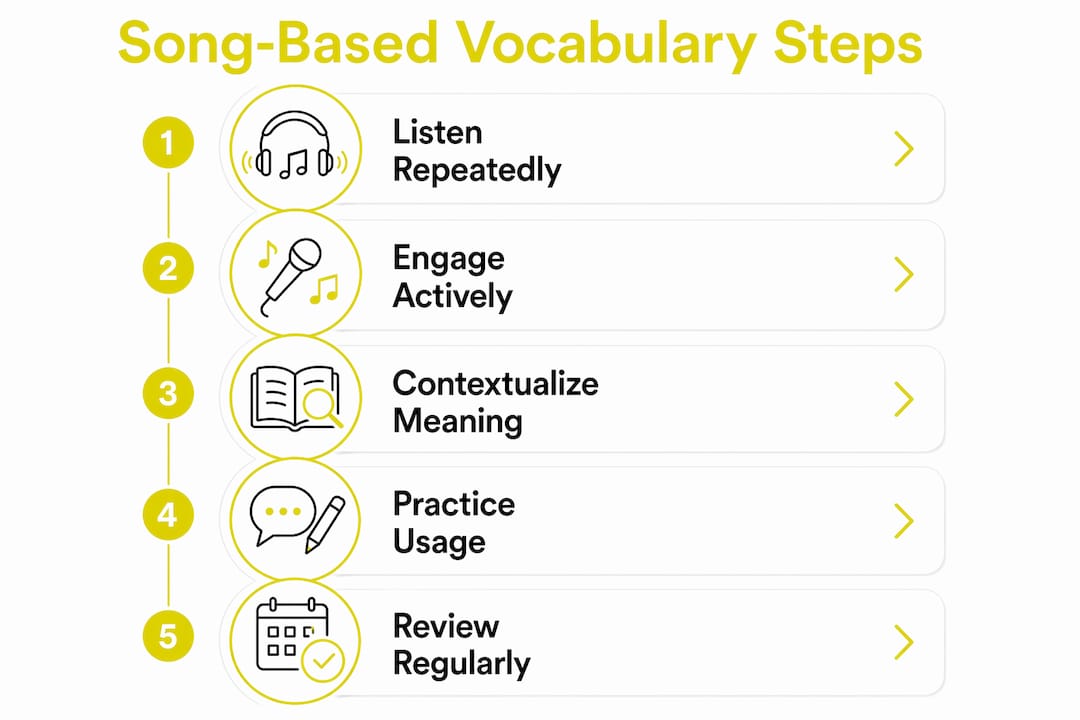
Effective activity design follows a simple input-output balance. Repeated listening provides the input. Gap-fill exercises, where you reconstruct missing lyrics from memory, force retrieval. Singing aloud adds motor memory and pronunciation practice. Writing sentences using the target vocabulary from the song completes the cycle by requiring production in a new context. Balancing input and output through this kind of task sequence is what separates high-yield song-based learning from casual music enjoyment.
For learners expanding vocabulary through music in a second language, resources like the language learner guide at Singwithcanary offer structured frameworks that apply exactly these principles.
What are the best song-based language activities to boost vocabulary?
The most effective song-based language activities share one feature: they require the learner to do something with the vocabulary, not just receive it. Passive listening alone produces weaker vocabulary acquisition than listening paired with structured output tasks. Here are the activity types that research and practice consistently identify as high-yield:
- Vocabulary prediction: Before listening, scan the song title and any available context. Predict five words you expect to hear. After listening, check your predictions. This primes your attention and activates prior knowledge.
- Lyric annotation: Print or display the lyrics and mark every unfamiliar word. After listening twice, look up definitions and write them in the margin using your own words.
- Gap-fill reconstruction: Remove ten to fifteen words from a printed lyric sheet before listening. Fill in the blanks as you listen. This forces active processing rather than passive reception.
- Structured discussion: After studying a song, discuss its theme with a language partner using at least five of the vocabulary items you identified. This moves words from recognition into production.
- Creative writing: Write a short paragraph or story using six to eight words from the song in new contexts. This is the highest-order task in the sequence and the one most likely to cement long-term retention.
Pro Tip: Pair your song-based activities with a social practice partner. Explaining a word’s meaning in the song to someone else forces you to retrieve and articulate it, which is one of the most powerful memory consolidation techniques available.
Technology makes these activities more accessible than ever. Singwithcanary’s platform integrates karaoke, vocabulary cards, and quizzes directly with song lyrics, so the gap between listening and structured practice collapses. For learners interested in song-based activities for fast progress, the platform provides ready-made activity sequences built around real songs. For those exploring creative language learning beyond conventional apps, resources like fun language learning games demonstrate how playful, music-adjacent methods transfer across different target languages.
Key takeaways
Song-based vocabulary learning works because it combines spaced repetition, emotional encoding, and contextual meaning into a single, enjoyable activity that outperforms rote memorization on both retention and real-world usage.
| Point | Details |
|---|---|
| Definition of song-based vocabulary | Vocabulary acquired through repeated, meaningful exposure to words in song lyrics rather than isolated lists. |
| Core cognitive mechanism | Dual-coding through melody and language creates stronger, more durable memory traces than text alone. |
| Research-backed retention | Vocabulary gains from repeated song listening persist after four weeks, indicating long-term memory encoding. |
| Song selection matters | Choose songs with frequent, level-appropriate vocabulary and clear lyrics to maximize acquisition. |
| Active tasks outperform passive listening | Gap-fill, lyric annotation, and production tasks drive significantly stronger vocabulary outcomes than listening alone. |
Why passive listening is the biggest trap in song-based learning
Most learners who try expanding vocabulary through music make the same mistake: they listen, enjoy, and assume absorption is happening automatically. It is not. Incidental vocabulary acquisition through songs requires repeated exposure, but repetition without attention produces familiarity, not knowledge. I have seen this pattern repeatedly. A learner spends weeks with a playlist and can hum every melody but cannot define half the words they have been hearing.
The shift that changes everything is moving from listener to analyst. The moment you pause a song to ask “what does that line actually mean?” you have activated the noticing mechanism that drives real acquisition. That noticing does not have to be laborious. It can be as simple as keeping a notes app open while you listen and flagging two or three words per session.
The emotional dimension of music is genuinely powerful, and I do not want to understate it. Songs that lower anxiety and increase motivation create the psychological conditions where learning accelerates. But emotion is the fuel, not the engine. The engine is structured engagement with the vocabulary itself. The learners who get the most out of song-based methods are the ones who let themselves love the music and then do the work of interrogating the lyrics.
My practical recommendation: pick one song per week, go deep on its vocabulary rather than skimming across ten songs, and make sure you produce the target words in at least one original sentence before moving on. Depth beats breadth every time in vocabulary acquisition.
— Ben
Take your song-based vocabulary learning further with Singwithcanary
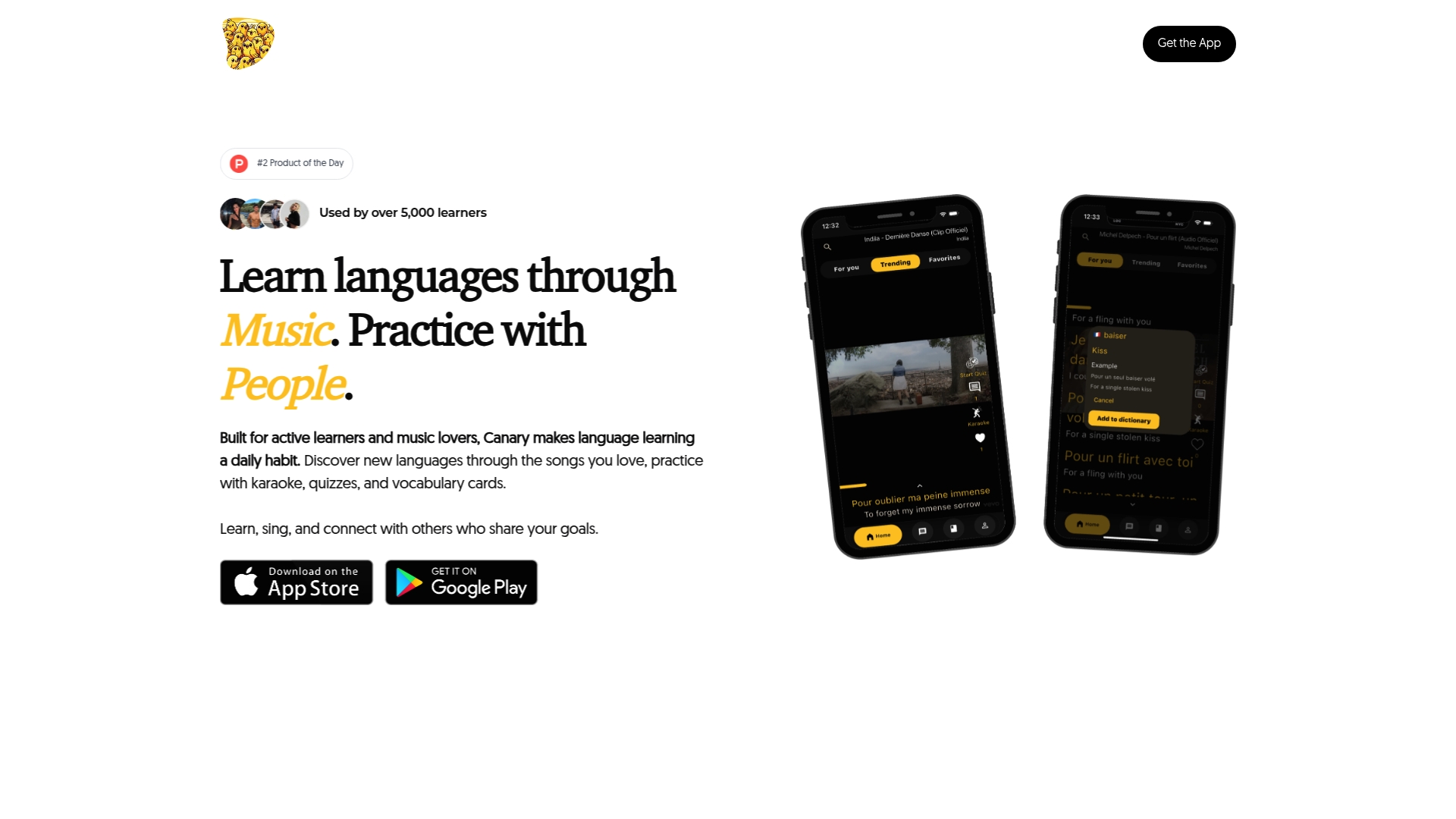
Singwithcanary is built specifically for learners who want to learn languages with music rather than through repetitive drills. The platform pairs real songs with interactive vocabulary cards, karaoke practice, and quizzes that apply the exact input-output balance the research supports. You are not just listening. You are noticing, producing, and practicing with a global community of learners who share your songs and your goals. Whether you are a beginner building foundational vocabulary or an advanced learner refining nuance and register, Singwithcanary structures the song-based activities that turn casual listening into measurable language progress. Start with the song of the week to see the method in action.
FAQ
What is the definition of song-based vocabulary?
Song-based vocabulary is vocabulary acquired through repeated, meaningful exposure to words embedded in song lyrics, rather than through isolated word lists or rote memorization. The method leverages incidental learning, emotional encoding, and spaced repetition to build durable vocabulary knowledge.
How do songs improve vocabulary retention compared to traditional methods?
Songs improve retention by encoding vocabulary through multiple channels simultaneously, including melody, emotion, and semantic context, which creates stronger memory traces than reading or drilling alone. Research with EFL learners shows vocabulary gains from song-based learning persist after four weeks of follow-up testing.
What makes a song good for vocabulary learning?
A good vocabulary-learning song contains frequently recurring words, clear and audible lyrics, level-appropriate language, and a meaningful narrative context that gives each word a semantic anchor. Avoid songs with heavily distorted vocals or vocabulary that falls far outside your current level.
Is passive listening to songs enough to learn vocabulary?
Passive listening alone produces weaker vocabulary acquisition than structured, active engagement with lyrics. Gap-fill exercises, lyric annotation, and production tasks that require you to use new words in original sentences consistently outperform unguided listening in research outcomes.
Can song-based vocabulary learning work for any language?
Song-based vocabulary learning applies to any language that has a recorded music tradition, which includes virtually every major world language. The cognitive mechanisms of dual-coding, emotional encoding, and spaced repetition through song structure operate independently of the specific language being learned.