Transfer in language learning is the way your brain applies knowledge from a language you already know when you try to speak or write a new one. The Oxford Advanced Learner’s Dictionary defines it as using your first language (L1) or another known language when producing the target language, a process also called L1 interference or cross-linguistic influence. That process can work for you or against you.
Here is the short verdict:
- Positive transfer speeds things up when your languages share patterns, cognates, or sounds.
- Negative transfer creates predictable errors when L1 rules conflict with L2 rules.
- Music and song-based practice, including karaoke and lyric shadowing, give you a structured way to exploit the similarities and retrain the conflicts.
- Interlanguage theory explains why transfer is normal, not a flaw.
- Singwithcanary packages these techniques into a daily music-first practice routine.
Table of Contents
- Positive vs. negative transfer: what actually changes your accuracy
- Why transfer happens: interlanguage and how your brain maps new rules
- How to leverage positive transfer and reduce negative transfer
- How music and songs specifically harness transfer
- How Singwithcanary puts transfer-aware drills into practice
- A practical 3-week plan using songs and targeted drills
- Common transfer errors and the drills that fix them
- Key Takeaways
- Why noticing transfer changed how I think about language practice
- Singwithcanary turns these techniques into a daily practice habit
- Useful sources
Positive vs. negative transfer: what actually changes your accuracy
Language transfer touches every level of a language: pronunciation, grammar, word order, vocabulary, spelling, and even social conventions. The table below shows how the two types play out in practice.
| Transfer type | What happens | Example |
|---|---|---|
| Positive transfer | L1 and L2 share a pattern; the learner gets it right automatically | A Spanish speaker recognizes nation, nation, nación as cognates and acquires the word faster |
| Positive transfer | Shared grammar rule applies correctly | French and English both use subject-verb-object order in simple sentences |
| Negative transfer | L1 rule conflicts with L2 rule | A Japanese speaker places the verb at the end of an English sentence: “I sushi eat” |
| Negative transfer | False friend misleads the learner | A Spanish speaker uses embarazada to mean “embarrassed” — it means “pregnant” |
| Negative transfer | L1 sound absent in L2 | An Arabic speaker substitutes a familiar phoneme for the English /p/ sound |
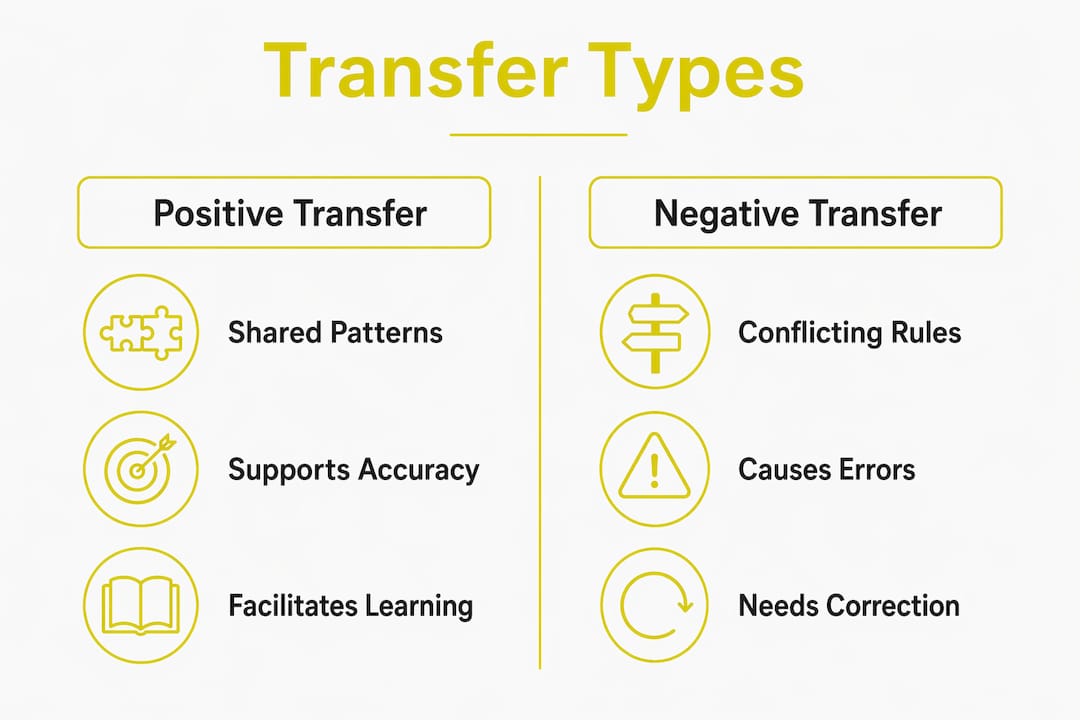
Positive transfer often goes unnoticed precisely because it produces correct forms. Negative transfer is louder: it shows up as an accent, a grammar slip, or a word that makes a native speaker pause. Both are worth tracking deliberately.
Why transfer happens: interlanguage and how your brain maps new rules
Your brain does not start from zero when you learn a new language. It builds what linguists call an interlanguage: a provisional grammar that sits between your L1 and the target language, borrowing rules from both and updating them as you get more input. Transfer is an active mapping strategy, not a sign of weakness or laziness.
Two kinds of transfer run simultaneously. Unconscious transfer happens automatically: your L1 rhythm sneaks into your L2 sentences before you notice. Conscious transfer is deliberate: you recognize a cognate or a shared rule and use it on purpose. The goal is to make more of your transfer conscious so you can steer it.
Pro Tip: Keep a one-week error log. Write down every mistake you catch yourself making in the target language. After seven days, sort the list: errors that mirror your L1 are transfer; errors that apply an L2 rule too broadly are overgeneralization. The two need different fixes.
How to leverage positive transfer and reduce negative transfer
Awareness alone does not fix transfer errors. Targeted, repetitive practice converts bad habits into accurate L2 production. Here is a practical sequence:
- Map your cognates. List 20 words in your L1 that look or sound similar to L2 words. Confirm the meanings match. These are free vocabulary — use them first.
- Identify your top three pronunciation contrasts. Find the sounds your L1 does not have. Record yourself saying them and compare to a native model.
- Run contrastive drills with short song chunks. Pick a four-bar phrase from a song. Say the L1 version, then the L2 version, back to back. The contrast makes the difference audible.
- Log false friends separately. Keep a running list of words that look like your L1 but mean something different. Review it weekly.
- Use L1 explanation strategically. A quick L1 gloss helps when a grammar rule is genuinely confusing. Avoid word-for-word translation for full sentences — it reinforces L1 word order.
- Measure your error rate. Count how many times a specific transfer error appears in a five-minute speaking sample. Repeat the drill. Recount. Progress becomes visible.
For vocabulary building specifically, building vocabulary fast through spaced repetition and context works alongside cognate mapping to lock in gains.
How music and songs specifically harness transfer
Song lyrics are pre-chunked language. A chorus repeats the same phrase four or more times per listen, which means your motor planning for pronunciation gets multiple reps without feeling like drilling. Processing language in rhythmic chunks reduces the pressure to translate word-for-word and helps you internalize L2 prosody, the natural rise and fall of the target language, rather than imposing your L1 rhythm onto it.
Three exercises you can start today:
- Lyric shadowing: Play a song line, pause, repeat it aloud immediately. Focus on matching the singer’s rhythm, not just the words. This overrides L1 word-order instincts because the melody locks in the L2 structure.
- Targeted pronunciation lines: Find one line in a song that contains your hardest sound. Sing it ten times at half speed, then at full speed. Slowing down lets your mouth find the correct position before muscle memory sets in.
- Cognate spotting in the chorus: Before you listen, scan the lyrics for words that resemble your L1. Confirm meanings. Then listen and notice how they sound in context. This turns positive transfer into a deliberate vocabulary strategy.
Pro Tip: Choose songs where you already understand 70–80% of the lyrics. Too much unknown vocabulary shifts your attention to decoding rather than pronunciation. Pop songs with simple, repeated choruses work better than complex ballads for this purpose. Explore song-based learning formats to find the style that fits your level.
How Singwithcanary puts transfer-aware drills into practice
Singwithcanary is built around exactly the techniques described above. Each feature maps to a specific transfer strategy:
- Karaoke mode forces you to match L2 prosody in real time, overriding L1 rhythm instincts the same way lyric shadowing does.
- Vocabulary cards surface cognates and flag false friends in context, so you build on positive transfer without falling into the false-friend trap.
- Ear training exercises train you to hear sounds your L1 does not have, which is the first step to producing them correctly.
- Pronunciation scoring gives immediate feedback on contrastive sounds, replacing guesswork with a measurable target.
- Social practice with other learners and native speakers exposes you to natural L2 prosody and gives you real-time correction that no solo drill can replicate.
The social layer matters for transfer specifically. Hearing how a native speaker phrases something, rather than how you would phrase it in your L1, is one of the fastest ways to notice and correct unconscious transfer. Singwithcanary’s music and social practice model builds that exposure into every session.

A practical 3-week plan using songs and targeted drills
| Week | Daily focus | Session length | Goal |
|---|---|---|---|
| Week 1 | Cognate mapping + lyric scanning | 20 min | Map your cognates; log false friends |
| Week 1 | Error log setup | 5 min | Categorize existing mistakes as transfer vs. overgeneralization |
| Week 2 | Pronunciation contrast drills with song lines | 20 min | Reduce errors on top 3 target sounds |
| Week 2 | Lyric shadowing at half speed | — | Match L2 rhythm on one full chorus |
| Week 3 | Full-speed karaoke + social practice | — | Sustain L2 prosody without reverting to L1 rhythm |
| Week 3 | Error log review | 5 min | Count reduction in logged transfer errors vs. Week 1 |
The interactive music methods that support this plan work best when sessions are short and daily rather than long and occasional. Twenty minutes every day beats two hours on the weekend for retraining motor habits.
Common transfer errors and the drills that fix them
Most transfer errors cluster in three areas. Knowing which category your mistake falls into tells you which drill to run.
Pronunciation errors (e.g., substituting an L1 phoneme for an L2 sound that does not exist in your native language): Find a song line with that sound. Sing it at half tempo ten times. Record yourself. Compare to the original. Repeat until the recordings match.
Word-order errors (e.g., placing the verb at the end of an English sentence because your L1 is verb-final): Write the L2 sentence correctly. Then sing a song line with the same structure. The melody physically carries the correct order into your memory.
False-friend vocabulary errors (e.g., using a word that looks right but means something else): Add it to your false-friend list immediately. Write the correct word next to it. Find a song that uses the correct word in context and listen to that line three times.
The key diagnostic question: does the error mirror something your L1 does? If yes, it is transfer and contrastive practice is the fix. If the error applies an L2 rule in the wrong place, that is overgeneralization and the fix is rule refinement, not contrast.
Key Takeaways
Transfer is normal, manageable, and fastest to fix when you combine awareness with targeted, music-based repetition rather than generic study.
| Point | Details |
|---|---|
| Transfer is universal | Every learner applies L1 knowledge to L2; the goal is to make that process conscious and strategic. |
| Positive transfer is free vocabulary | Cognates and shared grammar rules give you a head start — map them before you study anything else. |
| Negative transfer needs contrastive drills | Pronunciation and word-order errors from L1 conflict require targeted repetition, not just more input. |
| Music accelerates both | Chunked lyrics and karaoke repetition retrain prosody and pronunciation faster than isolated drills. |
| Singwithcanary applies this daily | Karaoke, vocabulary cards, ear training, and social practice combine to make transfer-aware learning a daily habit. |
Why noticing transfer changed how I think about language practice
Most learners treat their accent or their grammar slips as personal failures. They are not. They are your brain doing exactly what it is supposed to do: using every tool it already has to build something new. The problem is not that transfer happens. The problem is that most practice routines never make it visible.
The moment you start logging your errors and sorting them by cause, the picture changes. Transfer errors have a pattern. They repeat in the same spots, with the same sounds, in the same sentence positions. That predictability is actually good news: a predictable error is a targetable one. A song chorus that contains your hardest sound, repeated four times per listen, gives you more reps in three minutes than most grammar exercises give you in an hour.
Music does something else that drills alone cannot: it makes the correct version feel natural before you can explain why. That feeling is the L2 prosody taking hold. Once a phrase lives in your body as a melody, it stops competing with your L1 word order. That is the real payoff of song-based practice, and it is why the techniques in this article work faster than most learners expect.
Singwithcanary turns these techniques into a daily practice habit
If the strategies above sound like exactly what you have been missing, Singwithcanary is where they live in one place. Instead of building your own drill library from scratch, you get karaoke sessions that train L2 prosody, vocabulary cards that surface cognates and flag false friends, ear training that targets the sounds your L1 skips, and a community of learners and native speakers who give you real-time feedback.
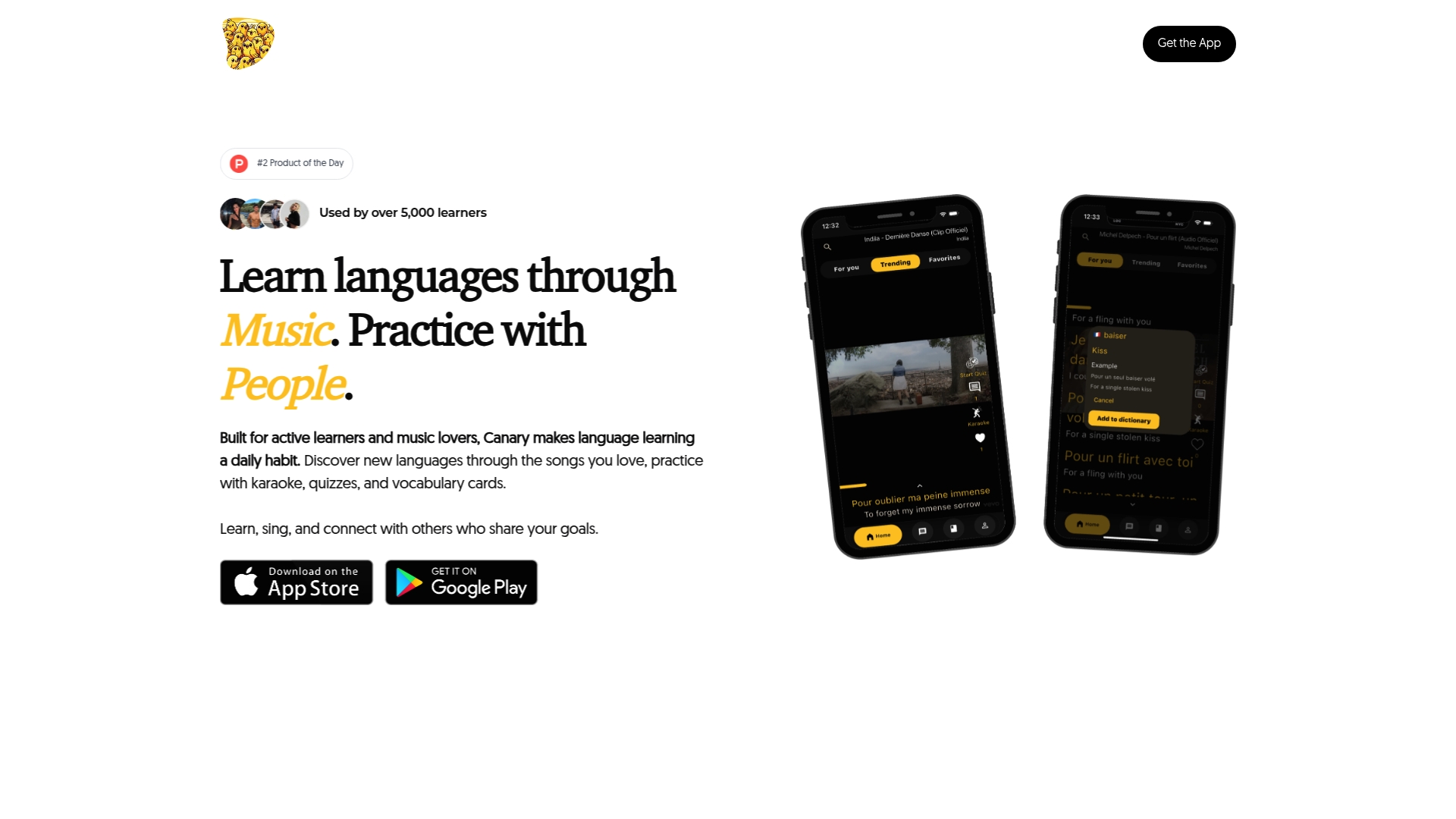
The song-of-the-week feature gives you a new, curated track every week with built-in exercises, so your transfer-aware practice stays fresh without any planning on your end. Sign up and start your first session today.
Useful sources
- Oxford Advanced Learner’s Dictionary — language transfer definition: The authoritative English-language definition; the starting point for any discussion of the term.
- Language transfer — Wikipedia: A broad overview of transfer across phonology, syntax, lexis, and pragmatics, with references to key researchers.
- Language transfer — Wiktionary: Concise entry covering interlanguage theory and the active-strategy framing of transfer.
- Language Transfer Types, Importance & Examples — Study.com: Practical breakdown of positive and negative transfer with examples; useful for distinguishing transfer from overgeneralization.
- Types of Language Transfer — Neliti: Research paper covering error types and the case for awareness-plus-repetition as the correction method.
- Language transfer theory — EduTech Wiki, University of Geneva: Explains chunking and prosodic learning as mechanisms for managing transfer through music.
- Singwithcanary — learn languages with music: Main platform page describing karaoke, vocabulary cards, ear training, and social practice features.
- Does listening to J-Pop help you pick up Japanese faster?: Explores how pop music aids vocabulary and listening skills in a real language-learning context.