TL;DR:
- Active learning involves students engaging with material through activities like discussion and problem-solving instead of passive listening. Research shows it significantly reduces failure rates, enhances retention, and develops skills valued by employers. Implementing active learning requires careful sequencing, scaffolding, and instructor effort but ultimately leads to deeper understanding and career readiness.
Active learning is defined as an instructional approach where learners engage directly with material through activities like discussion, problem-solving, retrieval practice, and peer teaching, rather than passively receiving information. This distinction is not semantic. Research consistently shows that active learning produces measurable gains in exam performance, long-term retention, and career-ready skills that passive lectures simply cannot match. Understanding why active learning matters gives educators and students a clear framework for designing experiences that actually stick.
Why active learning matters: what the research shows
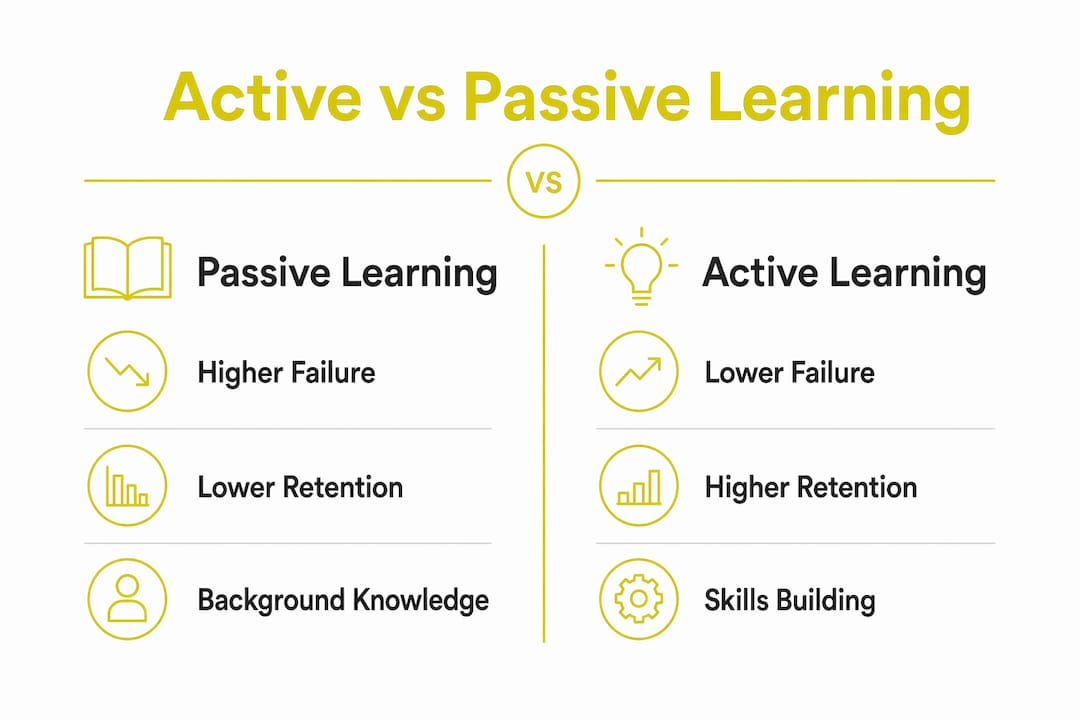
Students in active learning environments are 1.5 times less likely to fail and score about 6% higher on exams compared to traditional lecture courses. The failure rate in traditional courses averages 33.8% versus 21.8% in active learning settings. That gap represents thousands of students who pass or fail based on how instruction is designed, not how hard the material is.
The evidence holds across disciplines. A study published in PLOS One found that moderate to high-intensity active learning in STEM fields, including biology, chemistry, computer science, mathematics, physics, psychology, and public health, correlates with significantly higher exam scores regardless of class size. This matters because it rules out the common objection that active learning only works in small seminars.
Active learning also produces learning gains nearly two standard deviations above traditional instruction, with a measured performance improvement of 0.47 standard deviations. That is a large effect by any educational research standard. The mechanism is cognitive: active engagement forces learners to process information in retrievable chunks rather than absorbing it as a passive stream.
| Metric | Traditional Lecture | Active Learning |
|---|---|---|
| Average failure rate | 33.8% | 21.8% |
| Exam score improvement | Baseline | +6% |
| Learning gain (standard deviations) | Baseline | +0.47 |
| Cognitive load management | Passive reception | Active chunking |
| Long-term retention | Lower | Significantly higher |
How does cognitive science explain active learning?
The brain does not store information the way a hard drive saves a file. Memory formation requires active reconstruction, and that is exactly what active learning forces. John Sweller’s Cognitive Load Theory, developed at the University of New South Wales, explains that working memory has strict capacity limits. Passive reception of complex material overwhelms those limits. Active learning reduces passive overload by breaking content into retrievable schemas that move into long-term memory more efficiently.

Retrieval practice is the most studied mechanism. When you pull information out of memory rather than re-reading it, you strengthen the neural pathway to that information. The Center for Teaching Innovation at Cornell University describes this as “desirable difficulty.” The effort of retrieval feels harder in the moment but produces far more durable learning than passive review.
Elaborative interrogation adds another layer. When learners ask “why does this work?” and connect new information to what they already know, they build richer memory networks. A student who explains a math concept to a classmate is not just helping that classmate. The act of explaining forces the explainer to identify gaps and restructure their own understanding.
Pro Tip: Pace active exercises every 8–12 minutes during instruction. Long lectures without engagement diminish learning gains even when the content is excellent. A quick retrieval prompt, a pair discussion, or a prediction question resets attention and consolidates what was just covered.
Active learning vs. passive learning: which is better?
The honest answer is that neither method works well in isolation. Passive learning has genuine value for building background knowledge and vocabulary. Reading a chapter before class, watching an explanatory video, or listening to an expert lecture all provide the raw material that active learning then processes. The problem is when passive exposure is treated as the endpoint rather than the starting point.
| Approach | Strengths | Limitations |
|---|---|---|
| Passive learning | Efficient for background knowledge; low cognitive demand | Poor long-term retention without follow-up |
| Active learning | Strong retention; builds critical thinking | Requires more instructional design time |
| Sequenced approach | Combines both benefits | Needs deliberate planning to execute well |
The National Learning Authority frames this clearly: passive exposure builds vocabulary and context, but immediate active retrieval and application consolidate learning. Sequencing matters. A lecture followed by a problem-solving task outperforms a lecture alone, every time.
Common active learning techniques include Socratic discussion, think-pair-share, problem-based learning, peer instruction, and concept mapping. Common passive methods include listening to lectures, reading textbooks, and watching demonstrations. Both lists have a place in a well-designed course. The key is that active learning requires more instructional design effort upfront but leads to structural advantages like less re-teaching and greater learner independence over time.
How to implement active learning effectively
Starting with active learning does not mean abandoning lectures. It means redesigning the sequence. The most effective educators introduce passive content first, then immediately follow with an activity that requires students to use that content. This could be as simple as a two-minute written reflection, a peer explanation, or a quick decision-making scenario.
Scaffolding is non-negotiable for new learners. Many students initially struggle with active learning literacy, meaning they do not know how to engage productively in discussion, defend a position, or self-assess their understanding. Advance HE’s research confirms that embedding active learning culture and peer advocacy helps overcome reluctance and builds confidence over time. You cannot drop students into a Socratic seminar on day one and expect results.
Common pitfalls to avoid:
- Designing activities that are busy but not cognitively demanding (coloring timelines, copying notes)
- Skipping the debrief after an activity, which is where consolidation happens
- Treating group work as active learning without individual accountability built in
- Overloading a single session with too many activity types, which fragments attention
Pro Tip: Make student thinking visible before you explain. Ask learners to predict, estimate, or justify before you provide the answer. Surfacing student thinking first gives you real-time data on misconceptions and makes your explanation land with far more precision.
A student-tutor interaction model also accelerates active learning outcomes. When learners work with a more knowledgeable partner who asks questions rather than delivers answers, the learner is pushed to retrieve, justify, and apply knowledge in real time.
Does active learning build career-ready skills?
Active learning builds transferable skills that employers consistently rank above technical knowledge. The Bryan College research on active learning in college settings shows that employers value communication, teamwork, and adaptability, and these are exactly the capacities that active learning develops through practice, not just exposure.
The skills built through active learning methods include:
- Critical thinking: Analyzing problems, evaluating evidence, and forming defensible conclusions
- Communication: Articulating ideas clearly in discussion, writing, and presentation
- Collaboration: Working with peers toward shared goals with individual accountability
- Adaptability: Adjusting strategies when initial approaches fail
- Decision-making: Choosing among options under uncertainty, a skill built through case-based and problem-based learning
Active learning transforms knowledge into lived experience, equipping students to navigate real-world complexity rather than just recall facts on a test. This distinction matters enormously in a labor market where AI tools handle routine recall tasks. The human advantage lies in judgment, creativity, and collaboration, all of which active learning directly trains.
Advance HE frames active learning as essential for building transferable employability skills critical for future success beyond academic knowledge. That framing positions active learning not as a pedagogical preference but as a structural requirement for preparing students for careers that do not yet exist.
Key takeaways
Active learning reduces failure rates, strengthens long-term retention, and builds the critical thinking and communication skills that matter most in both academic and professional settings.
| Point | Details |
|---|---|
| Failure rate reduction | Active learning cuts failure rates from 33.8% to 21.8% compared to traditional lectures. |
| Cognitive science foundation | Retrieval practice and elaboration build durable memory by forcing active processing. |
| Sequencing passive and active | Passive exposure builds background knowledge; active retrieval immediately after consolidates it. |
| Scaffolding is required | Students need explicit training in active learning literacy before they can fully benefit. |
| Career skill development | Active learning builds communication, critical thinking, and adaptability valued by employers. |
Active learning is not optional anymore
I have watched educators debate active learning as if it were a stylistic choice, like whether to use slides or a whiteboard. That framing is wrong, and the data makes it indefensible. When you see a 12-percentage-point difference in failure rates, you are not looking at a preference. You are looking at an outcome gap that educators have the tools to close.
What I have found in practice is that the biggest barrier is not student resistance. It is teacher preparation. Designing a genuinely active lesson takes more time than preparing a lecture. You have to anticipate misconceptions, build in retrieval moments, and plan what you will do when students get it wrong. That is harder work. But the payoff is that you re-teach far less, and students leave with knowledge they can actually use.
The resistance from students is real but manageable. Most of it comes from unfamiliarity, not laziness. Students who have spent years being passive recipients of information need time to build active learning literacy. The solution is not to abandon the approach. It is to explain why you are doing it, scaffold the early activities carefully, and celebrate the moments when students surprise themselves with what they know.
My honest view is that active learning is not a trend. It is what good teaching has always looked like when it is working. The research just finally caught up with what the best educators already knew.
— Ben
Learn languages the active way with Singwithcanary
Active learning principles do not stop at the classroom door. Language acquisition is one of the clearest examples of why passive exposure alone never produces fluency.
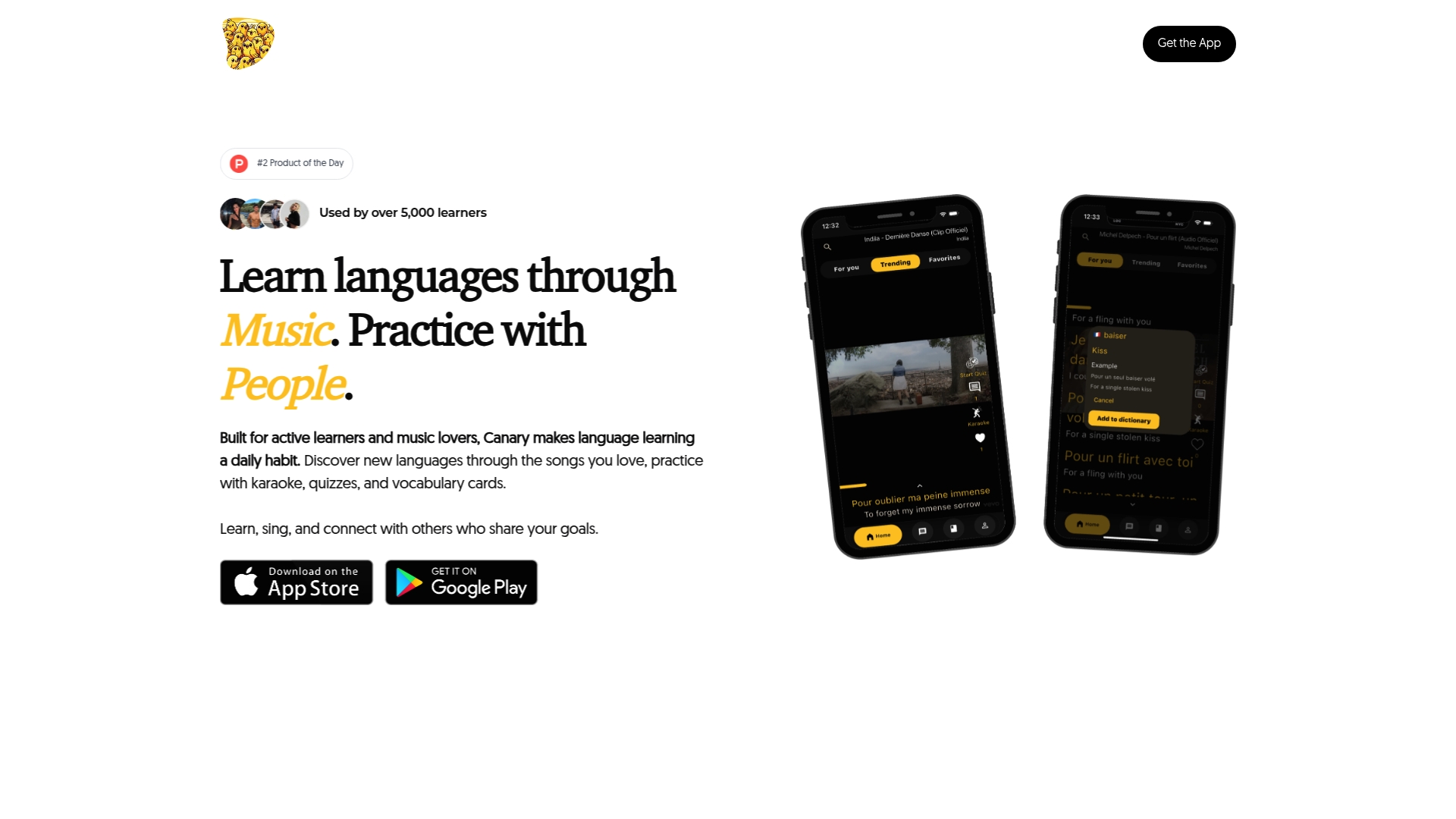
Singwithcanary applies active learning directly to language practice. The platform combines song-based learning with karaoke, vocabulary quizzes, and social interaction with international speakers, putting retrieval, application, and real-time feedback at the center of every session. You are not watching someone else speak. You are singing, practicing pronunciation, and building vocabulary in context. If you want to learn languages with music through a method grounded in the same principles that research shows actually work, Singwithcanary is built for exactly that kind of active, engaged practice.
FAQ
What is active learning in simple terms?
Active learning is any instructional method that requires learners to engage directly with material through activities like discussion, problem-solving, or retrieval practice rather than passively listening or reading.
How does active learning improve retention?
Active learning improves retention by forcing the brain to retrieve and apply information, which strengthens memory pathways. Research shows it produces learning gains 0.47 standard deviations above traditional instruction.
What are the most effective active learning techniques?
The most effective techniques include retrieval practice, peer instruction, think-pair-share, problem-based learning, and elaborative interrogation. Each method requires learners to process and apply content rather than simply receive it.
Is passive learning ever useful?
Passive learning is useful for building background knowledge and vocabulary, but it must be followed by active retrieval or application to produce durable retention. Sequencing passive exposure with active engagement maximizes outcomes.
Why do some students resist active learning?
Students resist active learning primarily because of unfamiliarity, not unwillingness. Scaffolding and explicit training in active learning literacy, along with clear explanations of why the approach works, significantly reduce resistance over time.