TL;DR:
- Song lyrics serve as an effective tool for language learning by embedding vocabulary within narrative and cultural contexts. They use metaphors, rhythm, and emotion to enhance memorability and deepen understanding compared to traditional methods. Active engagement with lyrics significantly improves vocabulary retention and cultural awareness.
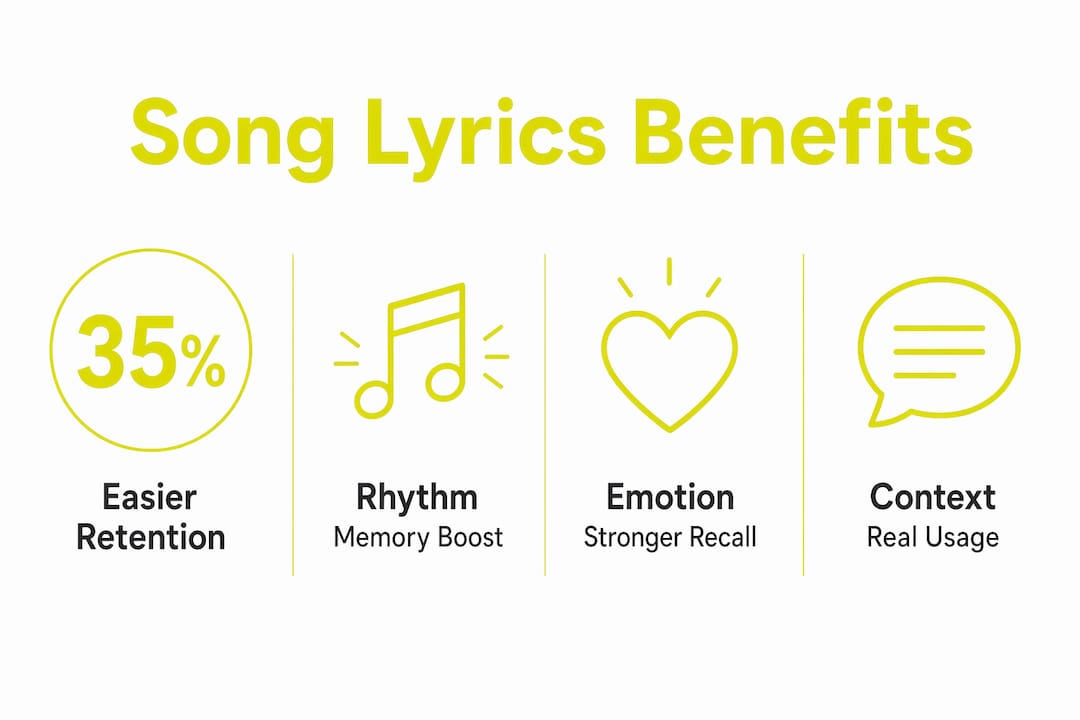
Song lyrics are defined as one of the most effective tools for contextual language learning because they embed vocabulary inside narrative, emotion, and cultural meaning simultaneously. Unlike flashcard drills or grammar exercises, lyrics give every word a job to do inside a story. Research shows that complex vocabulary is 35.71% easier to categorize and remember when it appears inside lyrical context rather than isolated lists. That single finding reframes the question of why choose song lyrics for context. The answer is not preference. It is cognitive science.
Why choose song lyrics for context: narrative and metaphor
Lyrics work because they use metaphor to make abstract ideas concrete. When a song describes heartbreak as a room you cannot leave, it uses what linguists call an ontological metaphor. That technique maps an emotion onto a physical space, giving learners a mental anchor for a word they might otherwise forget by morning.

The benefits of song-based language learning go far beyond simple repetition. Metaphor forces the brain to categorize new vocabulary by connecting it to something already understood. A word like “confinement” lands differently inside a lyric about a suffocating relationship than it does at the top of a vocabulary list.
Learners who study lyrics with this awareness gain three distinct advantages:
- Emotional anchoring: The feeling attached to a lyric creates a memory hook that pure definitions cannot replicate.
- Conceptual mapping: Metaphors like “emotions as containers” or “time as a river” teach abstract nouns through physical logic.
- Narrative reinforcement: Hearing a word used across multiple lines of a song builds understanding of its range and register.
Vocabulary lists teach you that a word exists. Lyrics teach you what a word feels like in use. That difference determines whether a word stays in your memory for a week or for a lifetime.
Pro Tip: When you read through a new song, underline every phrase that describes an emotion using a physical object or action. Those are your metaphors. Study them first, because they carry the most vocabulary weight per line.
What cognitive effects make song lyrics more memorable than other texts?
Rhyme and rhythm are not decorative features of a song. They are memory tools. The brain encodes information more reliably when it arrives in a predictable pattern, and lyrics deliver exactly that. Neurological studies confirm that rhyme, rhythm, and emotional resonance create mental shortcuts that reinforce long-term memory far more effectively than rote memorization.
Emotional connection amplifies this effect. A lyric tied to a strong feeling gets stored with more neural connections than a neutral sentence. That is why you can recall the words to a song you have not heard in ten years but forget a vocabulary list you studied last week.
Neuroscience also shows that music and language activate distinct but overlapping brain areas. That overlap is an advantage. When you engage with both the melody and the words at the same time, you are reinforcing the same vocabulary through two separate cognitive pathways at once.
Active engagement matters more than passive listening. Music drives a quicker emotional response than lyrics alone, which means the music can carry you emotionally without the words ever registering. Passive listening feels productive but often is not.
Four steps make lyric study cognitively active:
- Listen once without reading. Let the melody and emotion land first.
- Read the lyrics silently. Focus on meaning, not sound.
- Listen again while reading. Match sound to meaning in real time.
- Sing or speak the lyrics aloud. Activate your speech production system alongside comprehension.
Pro Tip: Process the music and the lyrics separately on your first two passes. This forces your brain to engage each pathway independently before combining them, which deepens retention.
How does interpreting song lyrics build critical thinking and cultural awareness?
Lyric interpretation is not about finding the one correct meaning. Experts describe it as evidence-based and multi-dimensional, meaning every reading you build from a lyric is a critical thinking exercise. That process trains a skill that transfers directly to reading news articles, understanding conversations, and navigating real-world language.
Cultural awareness grows from the same practice. Songs with social commentary or historical themes move learners beyond dictionary definitions into the lived experience of a language community. A protest song from the 1960s teaches you what words meant to the people who used them, not just what they mean in isolation.
Three lyrical features reveal deeper meaning when you pay attention to them:
- Repetition: A repeated line is rarely just a hook. It is the emotional thesis of the song. When the wording of a repeated line changes slightly, that shift signals internal conflict or narrative irony.
- Inconsistencies: When a lyric contradicts itself, the contradiction is usually the point. Learners who notice these moments develop sensitivity to subtext.
- Narrative shifts: A song that changes perspective or tense mid-verse is showing you a character’s growth or self-deception. Reading that shift correctly requires the same skill as reading between the lines in a conversation.
“Choosing songs with complex themes bridges language learning with cultural identity and social awareness.” This is not a bonus feature of lyric study. It is the core mechanism.
Researching the extralinguistic context of a song, meaning the artist’s background, the cultural moment, and any interviews where they explain their intent, unlocks meanings that the text alone cannot deliver. Advanced learners who research this context consistently outperform those who rely on the lyrics alone for comprehension.
What practical methods help learners study language through song lyrics?
Effective lyric study follows a structure. Without one, most learners drift into passive enjoyment, which feels good but produces limited language gains. The methods below turn a song into a full study session.
- Choose songs with intention. Pick tracks that match your current level but stretch it slightly. Songs with social themes, storytelling, or emotional complexity give you more to work with than simple pop hooks.
- Process music and lyrics separately first. Listen without the text, then read without the music. This prevents the melody from carrying you past words you do not actually understand.
- Research the context before you analyze. Look up the artist’s background, the year the song was released, and any interviews where they discuss the track. Contextual research unlocks idiomatic meanings that the text alone cannot explain.
- Mark every word or phrase you cannot define precisely. Do not guess from context alone. Look it up, then write a sentence using it in a different context to confirm you understand it.
- Return to the song after a week. Spaced repetition applied to lyrics works the same way it works for flashcards, but the emotional memory of the song makes retrieval faster and more reliable.
- Use repetition as a study signal. When a phrase repeats, treat it as a vocabulary priority. The songwriter chose to repeat it because it carries the most meaning. You should study it for the same reason.
Platforms like Singwithcanary build this structure into the learning experience directly, pairing lyrics with vocabulary cards, karaoke practice, and quizzes so each step of the process has a dedicated tool.
Key Takeaways
Song lyrics are the most effective contextual learning tool available to language learners because they combine narrative, metaphor, rhythm, and cultural meaning into a single, emotionally engaging format.
| Point | Details |
|---|---|
| Metaphor accelerates retention | Lyrics using ontological metaphors make complex vocabulary 35.71% easier to categorize and remember. |
| Rhythm creates memory shortcuts | Rhyme and rhythm encode vocabulary through neural pathways that rote memorization cannot reach. |
| Active listening is non-negotiable | Processing music and lyrics separately prevents passive consumption and deepens semantic engagement. |
| Interpretation builds critical thinking | Analyzing repetition, inconsistencies, and narrative shifts trains skills that transfer to real-world language use. |
| Context unlocks full meaning | Researching an artist’s cultural moment and interviews reveals idiomatic meanings invisible in the text alone. |
Why lyrics changed how I think about language learning
I spent years watching learners grind through vocabulary lists and make slow, frustrating progress. Then I watched the same learners pick up a song they loved and absorb twenty new words in a single afternoon without feeling like they were studying at all. That gap is not a mystery once you understand what lyrics actually do.
The conventional wisdom says music is a supplement to real language study. I think that gets it exactly backward. Lyrics are the most realistic simulation of how language actually works in human communication. Every real conversation involves emotion, subtext, cultural reference, and implied meaning. Lyrics train all of those skills at once.
The pitfall I see most often is learners who listen without ever stopping to interrogate what they heard. They enjoy the song, feel good about the exposure, and move on. That is not study. The learners who make real gains are the ones who treat a lyric like a puzzle. They ask why a word was chosen, what it implies, and what it would mean if a different word had been used instead.
The emotional resonance of music is not a distraction from learning. It is the mechanism. When a song moves you, your brain is already doing the work of encoding it. Your job is to make sure the words come along for the ride.
— Ben
Learn languages with music through Singwithcanary
Singwithcanary is built on the principle that learning with music produces faster, more lasting results than traditional methods. The platform combines song lyrics with vocabulary cards, karaoke practice, and interactive quizzes so learners engage with language the way the brain actually retains it.

Every week, Singwithcanary features a curated song of the week with guided lyric analysis, cultural context, and pronunciation practice built in. Learners also connect with speakers from around the world, turning lyric study into real conversation practice. If you are ready to move beyond vocabulary lists and into language that actually sticks, sign up and start learning with music today.
FAQ
Why are song lyrics better than vocabulary lists for learning?
Lyrics embed words inside narrative and emotional context, making them 35.71% easier to categorize and remember than isolated vocabulary. Context gives each word a function, which is how the brain stores language for long-term use.
How does rhythm help with language retention?
Rhyme and rhythm create mental shortcuts that reinforce long-term memory more effectively than rote repetition. The brain encodes patterned input more reliably, which is why song lyrics stay in memory long after a vocabulary list fades.
Does passive listening to songs count as language study?
Passive listening alone produces limited gains. Music drives emotional response faster than lyrics, which means you can absorb the feeling of a song without processing the words. Active lyric analysis is required for real vocabulary acquisition.
How do song lyrics build cultural awareness?
Songs with social or historical themes teach learners what words meant to the people who used them, not just their dictionary definitions. That lived cultural context is impossible to get from a textbook alone.
What should I research before analyzing a song’s lyrics?
Research the artist’s background, the cultural moment when the song was released, and any interviews where the artist explains their intent. Extralinguistic context unlocks idiomatic meanings that the text alone cannot reveal.