TL;DR:
- Daily practice with music significantly improves language retention, pronunciation, and fluency.
- Consistent short sessions build stronger neural pathways and boost long-term memory more than weekly cramming.
- Incorporating songs reduces anxiety, increases motivation, and enhances cognitive and brain health benefits.
Ten minutes a day beats two hours on the weekend. That sounds wrong, but the research is clear: daily practice delivers 80% retention after three months, while weekly cramming sessions of equal total time produce only 35%. For music enthusiasts and active language learners, this changes everything. Short, consistent sessions, especially when built around songs and lyrics, accelerate vocabulary growth, sharpen pronunciation, and make the whole process something you actually look forward to. This article breaks down the science, the strategies, and the specific ways music can transform your daily practice into your most powerful learning tool.
Table of Contents
- The science behind daily language practice
- How daily practice powers vocabulary and pronunciation growth
- The unique edge of song-based daily practice
- Making daily practice stick: Habit formation and sustainability
- Beyond language: The cognitive and lifelong benefits of daily practice
- What most language learners miss about daily practice (and music)
- Ready to make daily language learning irresistible?
- Frequently asked questions
Key Takeaways
| Point | Details |
|---|---|
| Daily practice delivers results | Short, regular language sessions build stronger skills than long, infrequent ones. |
| Song-based learning accelerates growth | Music makes vocabulary and pronunciation practice more effective and memorable. |
| Forming habits is key | Making language study a daily habit keeps progress on track and prevents burnout. |
| Cognitive benefits extend beyond language | Daily language routines sharpen your brain and protect long-term mental health. |
| Anyone can succeed with the right routine | Integrating music and daily habits unlocks even greater language learning potential. |
The science behind daily language practice
Your brain does not store language the way a hard drive saves files. It builds networks. Every time you encounter a word, phrase, or sound pattern, neurons fire together and strengthen their connection. Miss a day and that connection fades a little. Come back the next day and it rebuilds, slightly stronger. That cycle, repeated daily, is what creates fluency.
A 2021 MIT study found that learners who practiced 15 minutes every day reached fluency benchmarks faster than those who studied for two hours twice a week, even though the total hours were identical. The reason? Daily repetition strengthens neural pathways seven times more effectively than massed practice. Frequency is the variable that most learners underestimate.
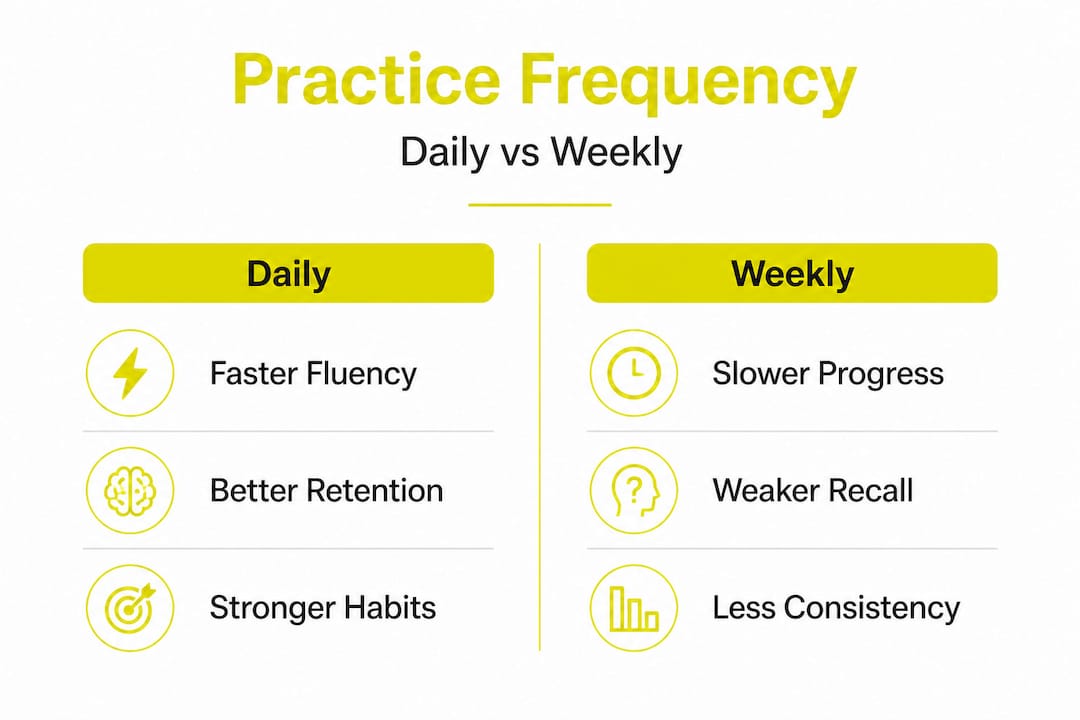
Sleep plays a bigger role than most people realize. Every night, your brain consolidates what you learned that day, moving information from short-term to long-term memory. Daily practice gives you 365 consolidation cycles per year. Weekend-only practice gives you 104. That difference compounds dramatically over months, boosting both declarative memory (vocabulary and grammar rules) and procedural memory (speaking and pronunciation fluency).
Here is a quick comparison of how practice frequency affects outcomes:
| Practice schedule | Annual sleep consolidations | 3-month retention | Neural pathway strength |
|---|---|---|---|
| 10 min daily | 365 | ~80% | Very high |
| 70 min weekly | 52 | ~35% | Moderate |
| 2 hrs twice weekly | 104 | ~50% | High |
| Monthly marathon | 12 | ~15% | Low |
Spaced repetition, the technique of reviewing material at increasing intervals, works best when you practice every day. Without daily touchpoints, the spacing intervals collapse and retrieval becomes harder. Apps and music-based language guides that use spaced repetition alongside song lyrics give you both the frequency and the emotional hook needed for deep retention.
Key cognitive benefits of daily practice:
- Strengthens neural pathways through consistent activation
- Maximizes sleep-based memory consolidation every single night
- Supports spaced repetition cycles for long-term vocabulary retention
- Prevents the “forgetting curve” from resetting your progress
- Builds automaticity, so language starts to feel instinctive
“Consistency is not about perfection. It is about showing up often enough that your brain starts treating the language as familiar rather than foreign.”
Pro Tip: If you miss a day, do not try to double up the next session. Just return to your regular length. Doubling up disrupts spaced repetition timing and can actually slow retention.
How daily practice powers vocabulary and pronunciation growth
Knowing that daily frequency matters at a neurological level is useful. But let us get specific about what that means for vocabulary and pronunciation, the two areas where music learners tend to see the most dramatic results.
Vocabulary retention is not just about exposure. It is about the number of times you encounter a word in meaningful context. Research consistently shows that a word needs between 10 and 20 meaningful encounters before it moves into active vocabulary. Daily practice dramatically increases the rate at which those encounters happen, especially when you are working with song lyrics that repeat phrases across verses and choruses.
A University of Cambridge 2020 study found that daily exposure develops native-like pronunciation three to four times faster than infrequent practice with the same total hours. The reason is feedback frequency. When you practice daily, you get more opportunities to hear your own output, compare it to native models, and adjust. Pronunciation is a motor skill as much as a cognitive one, and motor skills improve through repeated, frequent practice, not occasional long sessions.

Here is how daily and weekly practice compare across key learning outcomes:
| Learning outcome | Daily 15-min practice | Weekly 105-min session |
|---|---|---|
| Vocabulary retention (3 months) | ~80% | ~35% |
| Pronunciation accuracy gain | 3-4x faster | Baseline |
| Speaking confidence | High | Moderate |
| Plateau risk | Low | High |
| Learner dropout rate | Lower | Higher |
Breaking learning into daily chunks also prevents cognitive overload. When you try to absorb too much in one session, your working memory gets saturated and retention drops sharply. Smaller daily doses keep you within your brain’s optimal processing range.
A practical daily vocabulary routine:
- Review five words from yesterday using a flashcard or vocabulary card app
- Listen to one verse of a target-language song and identify any new words
- Repeat the chorus out loud, focusing on pronunciation and rhythm
- Write or say one original sentence using a new word
- Note any words you struggled with for tomorrow’s review
Understanding the educational benefits of music helps explain why song-based vocabulary work outperforms reading lists alone. Melody and rhythm create additional memory anchors, so words learned through songs tend to stick faster and longer. You can also explore real examples of music for language success to see how learners at different levels have applied these strategies.
Stat to know: Learners who practiced pronunciation daily for 90 days showed measurable native-like prosody (natural speech rhythm and intonation), while those practicing weekly showed minimal prosody improvement despite equivalent hours.
The unique edge of song-based daily practice
Daily practice is powerful. Daily practice with music is something else entirely.
Songs engage your brain on multiple levels simultaneously. You are processing melody, rhythm, meaning, and emotion all at once. That multi-channel engagement is what researchers call dual coding, and it creates stronger, more durable memories than single-channel input like reading a textbook.
An experimental study on song-based vocabulary retention found that learners using songs gained 33 points on vocabulary assessments compared to just 15 points for traditional study groups. That is more than double the gain, with the same amount of study time. The difference comes from rhythmic entrainment (your brain syncing to the beat), emotional engagement, and the natural repetition built into song structure.
Anxiety is one of the biggest barriers to language practice. Many learners avoid speaking because they fear making mistakes. Music lowers that barrier significantly. When you are singing along to a chorus, you are not thinking about grammar rules. You are just producing sounds, and that relaxed state is exactly when pronunciation improves fastest.
Music-based retrieval combined with spaced repetition also enhances verbatim phonetic recall, meaning you remember not just the meaning of a word but exactly how it sounds. This is critical for developing a natural accent and for understanding fast, native-speed speech.
Why songs work so well for daily language practice:
- Melody and rhythm create multiple memory anchors for each word
- Repetition within songs mirrors spaced repetition principles naturally
- Emotional connection to music increases motivation to return daily
- Singing reduces speaking anxiety, leading to more frequent output attempts
- Phonetic patterns in lyrics train your ear to native-level sound distinctions
Exploring the benefits of song-based learning gives you a deeper look at the research behind these effects. For practical strategies tailored to music lovers, the music lovers’ learning tips resource is a strong starting point.
Pro Tip: Choose songs you genuinely enjoy, not just songs that seem educational. Emotional investment in the music dramatically increases how often you return to it, which is the single most important factor in daily habit formation.
Making daily practice stick: Habit formation and sustainability
Knowing what to do is not the same as doing it every day. The gap between knowledge and habit is where most language learners lose momentum. Here is how to close that gap.
Research on habit formation shows that daily behaviors become automatic after 66 days on average. That is your target window. For the first two months, you need structure and triggers. After that, the habit runs on autopilot.
Habit stacking is one of the most effective methods for building consistency. You attach your language practice to an existing daily behavior. For example, you practice vocabulary while your morning coffee brews, or you listen to a target-language song during your commute. The existing habit acts as a trigger for the new one.
A five-step system for building a lasting daily practice habit:
- Choose a specific time and location for your daily session (same spot, same time)
- Start with just five minutes, not fifteen, to reduce resistance in the first two weeks
- Stack your practice onto an existing habit like breakfast, commute, or gym warm-up
- Use a song-based app or playlist to make the session feel like entertainment, not study
- Track your streak visually, a simple calendar with X marks works, to activate the “don’t break the chain” motivation effect
Combining music with spaced repetition software creates a system that is both enjoyable and scientifically optimized. You get the emotional pull of music and the cognitive efficiency of timed review intervals. The role of music in learning explores how these two elements reinforce each other in ways that traditional apps cannot replicate.
“The goal is not to study every day. The goal is to make daily practice feel like something you would miss if you skipped it.”
Pro Tip: On days when motivation is low, commit to just one song. One chorus. One minute. Starting is almost always the hardest part, and a tiny session is infinitely better than no session for maintaining your streak and neural momentum.
Accountability also matters. Sharing your progress with a language partner or online community creates social commitment that keeps you consistent during low-motivation periods. Platforms that combine music with social interaction give you both the content and the community in one place.
Beyond language: The cognitive and lifelong benefits of daily practice
The payoff for daily language practice goes far beyond speaking a new language. Your brain changes in measurable ways, and those changes benefit you across every area of life.
Documented cognitive benefits of daily language learning:
- Neuroplasticity: Regular language exposure stimulates the growth of new neural connections, keeping your brain adaptable and sharp
- Executive function: Switching between languages strengthens the prefrontal cortex, improving focus, decision-making, and mental flexibility
- Working memory: Managing two language systems simultaneously expands your capacity to hold and manipulate information
- Delayed cognitive decline: Bilingual daily use delays dementia onset by an average of four to five years, a finding replicated across multiple large-scale studies
- Cognitive reserve: Daily language learning builds a buffer of brain resilience that protects against age-related decline
These benefits are not reserved for people who achieve full fluency. Even intermediate daily learners show measurable improvements in executive function and working memory. The key variable is consistency, not proficiency level.
Stat to know: Research shows that bilingual individuals who use both languages daily show stronger cognitive reserve and better outcomes on executive function tests compared to monolingual peers, regardless of the languages involved.
Language learning is one of the few activities that simultaneously challenges memory, attention, auditory processing, and social cognition. When you add music to that mix, you also activate emotional processing and motor coordination. That is a full-brain workout in fifteen minutes a day.
What most language learners miss about daily practice (and music)
Here is the uncomfortable truth: most learners spend more time optimizing their study plan than actually studying. They research apps, compare methods, and build elaborate schedules, then skip practice when life gets busy because the process feels like work.
The real secret to language fluency is not finding the perfect method. It is finding a method you will actually do every single day for months. That is where music changes the equation entirely.
Conventional wisdom in language learning still overvalues long, structured study sessions. Grammar workbooks, vocabulary lists, and formal lessons all have their place. But they fail the sustainability test. Nobody wakes up excited to drill conjugation tables. People do wake up wanting to hear a song they love.
The educational advantages of music are not just about retention statistics. They are about removing the friction that causes learners to quit. When your daily practice feels like listening to music, you stop negotiating with yourself about whether to do it. It becomes something you want, not something you have to do.
We have seen this pattern repeatedly: learners who switch from textbook-first approaches to music-first approaches do not just improve faster. They stay in the game longer. And in language learning, time in the game is everything. Fluency requires 600 to 750 hours of quality exposure. The only realistic path to that number is a daily habit you genuinely enjoy.
The learners who reach fluency are not the ones with the best study materials. They are the ones who found a way to make practice feel like play.
Ready to make daily language learning irresistible?
If the research in this article has you ready to rethink your approach, you do not need to overhaul everything at once. Start with one song. One daily session. One platform designed to make that session feel effortless.
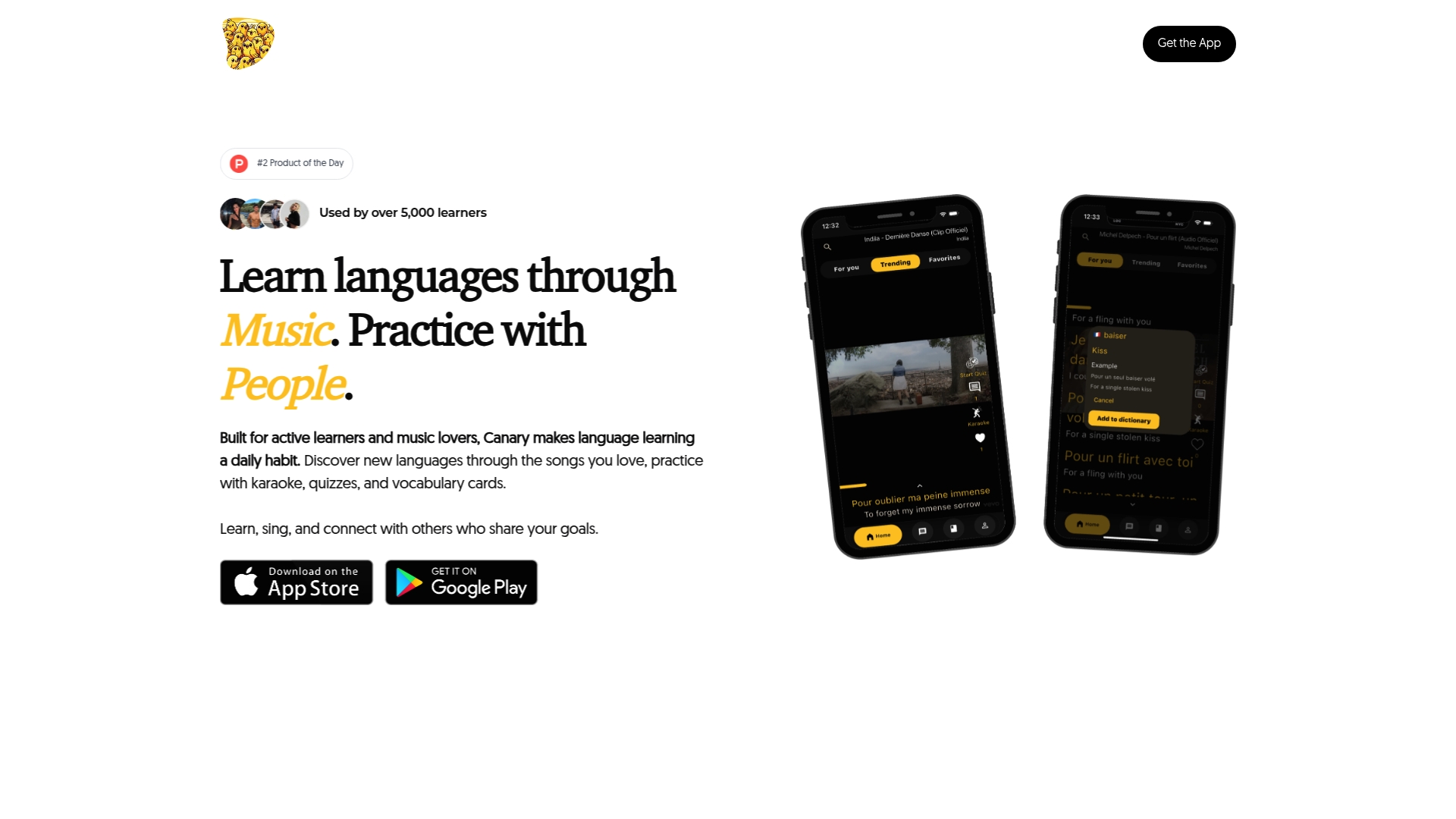
Canary is built specifically for music enthusiasts who want to learn languages with music every single day. The platform combines song-based vocabulary cards, karaoke-style pronunciation practice, and quizzes that turn lyrics into learning tools. You can explore the song of the week feature to get a fresh, curated track with built-in learning activities delivered regularly. Every session is designed to feel like entertainment while delivering the daily frequency your brain needs. If you want to understand exactly what makes this approach so effective before diving in, the song-based learning benefits page lays it all out clearly. Your daily habit starts with one song you love.
Frequently asked questions
How many minutes a day should I practice a new language?
Research shows that 10 to 15 minutes daily leads to significantly higher retention and faster fluency progress than infrequent long sessions, even when total hours are equal.
Are song-based methods truly effective for language learning?
Yes. Studies show song-based learning boosts vocabulary by more than double compared to traditional methods, while also improving pronunciation accuracy and reducing speaking anxiety.
How long does it take for daily practice to become a habit?
Most learners make language practice automatic after approximately 66 days of consistent daily effort, at which point the behavior requires far less conscious motivation to maintain.
Does daily practice help with more than just language skills?
Daily language learning also builds cognitive reserve and boosts executive function, with bilingual daily use linked to delayed onset of dementia and stronger overall brain health.
What’s better: short daily sessions or occasional study marathons?
Regular daily sessions consistently outperform marathon study blocks for fluency, memory, and retention, primarily because daily spaced repetition strengthens neural pathways far more effectively than massed practice.