The most effective workflow for immersive German learning combines daily integrated practice across reading, writing, listening, and speaking with structured grammar study and massive exposure to real German content. Learners who follow this approach, rather than relying on apps alone, can reach intermediate fluency (B2 level) in 12–18 months with 1–2 hours of daily commitment plus additional passive listening. The key is not grinding harder. It is designing your environment and schedule so German surrounds you by default.
Here is what a complete immersive workflow looks like at a glance:
- Daily integrated practice across all four skills: reading, writing, listening, and speaking
- Structured grammar study paired with massive real German input (TV, podcasts, graded readers)
- Comprehensible input at i+1 level, meaning content just slightly above your current ability
- Split study sessions with breaks, not marathon blocks, to let the brain consolidate
- Passive listening during commutes, chores, and exercise to accumulate bonus contact hours
- Speaking from week one through self-talk, shadowing, and tutor sessions to build muscle memory early
How do you start immersive German learning effectively?
Start by locking in your “why.” Whether you want to work in Berlin, connect with family, or simply love the language, your motivation shapes every immersion choice you make. A learner chasing business fluency picks different podcasts and reading material than someone learning for travel.
Once you have your goal, set up your German environment before you open a single textbook. Change your phone’s operating system language to German today. It feels awkward for about a week, then you absorb 50–100 high-frequency words (Einstellungen, Nachrichten, Kontakte) without any deliberate effort. Do the same for your browser and default streaming audio.
From day one, speak out loud. Name objects around your room, repeat sentences you hear, mimic pronunciation. It takes time to build the physical muscle memory for German sounds, and the earlier you start, the less you have to unlearn later.
- Set your motivation and let it guide your media and topic choices
- Switch device languages to German immediately for passive vocabulary exposure
- Use beginner-friendly media with subtitles: Easy German on YouTube, Nicos Weg on DW
- Start Anki with a German Core 2000 deck, always learning nouns with their article (die Tasse, not just Tasse)
- Establish a fixed daily schedule of at least 60 minutes of active study, even on busy days
- Speak from day one through simple sentences, self-talk, and mimicking audio
The German vocabulary building process that sticks is one built on consistent daily repetition, not occasional cramming sessions.
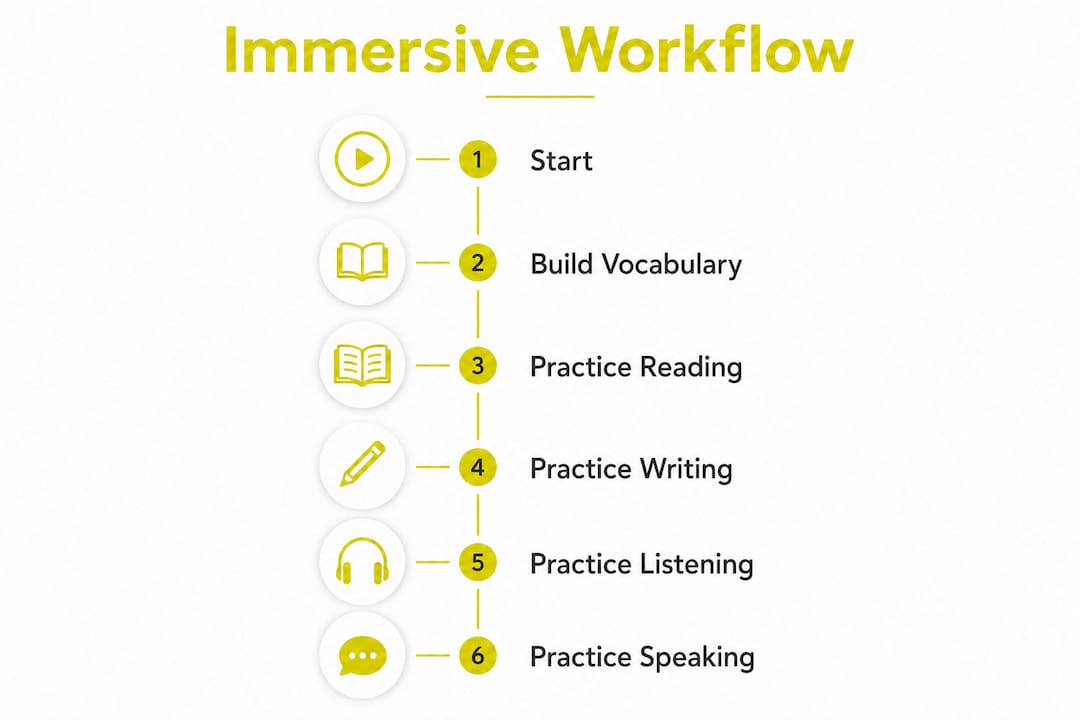
Practicing all four skills in your immersion routine
Immersion fails when learners treat it as passive consumption. Real acquisition happens when you work all four skills deliberately, and each one feeds the others.
Reading
Start with graded readers from publishers like Hueber, which pitch content at A1 through B2 levels with vocabulary glossaries at the end of each chapter. Once you hit A2, add Nachrichtenleicht.de for simplified news. By B1, move to full German news sources like Tagesschau. The rule: if you are looking up every third word, the text is too hard. Aim for 70–80% comprehension and look up only words that block understanding entirely.

Frequency dictionaries are underused by most learners. Working through the top 2,000 German words in context, rather than random vocabulary lists, closes comprehension gaps faster than any other reading strategy.
Writing
Write five sentences in German every day, minimum. In the early weeks, use today’s grammar topic as the frame. By month three, keep a short journal: what you did, what you watched, what confused you in German that day. Post to communities like r/German for corrections. The act of producing language, even imperfectly, reveals gaps that passive input never surfaces.
Listening
Layer your listening exposure progressively. Weeks 1–4: Slow German podcast and Easy German episodes you have already watched. Months 3–4: DW Radio as background, Coffee Break German for structured input. Months 5–6: Spiegel Update podcast, German YouTube channels in your interest area, and German TV with German subtitles only. The ear training process for German learners is gradual. Pulling English subtitles too early is the most common mistake.
Speaking
Regular speaking sessions with a community tutor (three times per week is a solid target) combined with daily self-monologues cover both corrected output and free production. Before each tutor session, write 5–10 sentences on what you want to discuss and look up five vocabulary words you will need. During the session, keep talking even when you make mistakes. Stopping mid-sentence to self-correct is worse for fluency than finishing incorrectly and getting corrected afterward.

Pro Tip: Shadow audio you have already understood, not new material. Shadowing incomprehensible content produces nothing useful. Start with Easy German clips you have watched at least once, then graduate to DW Radio and German films by month five.
How does comprehensible input work, and how do you balance active vs. passive learning?
The i+1 principle is the foundation of effective immersion. Input must be just slightly above your current level: mostly understandable, with enough unfamiliar material to stretch you. Content that is too easy produces boredom and no acquisition. Content that is too hard produces noise and no acquisition either.
Active learning means conscious engagement: drilling grammar, reviewing Anki cards, speaking with a tutor, writing sentences. Passive learning means incidental exposure: German radio in the background, a podcast during your commute, German audio while cooking. Both matter, but they are not interchangeable. Passive exposure alone will not get you to B1. It supplements structured study; it does not replace it.
- Active learning (grammar drills, Anki, speaking, writing) builds the structural foundation
- Passive listening accumulates contact hours and normalizes German sound patterns
- Raise difficulty gradually: German subtitles replace English ones at week nine; native-speed TV replaces slow podcasts by month five
- Use the Device Immersion Protocol to create a German-default environment for continuous incidental learning
Immersion isn’t study hours. It’s contact hours — how much German your brain processes in a day, including background input, active listening, reading, and conversation. A learner who studies one hour but encounters German for four more hours through media, labels, and conversations has five contact hours. That’s immersion: environment design, not effort escalation.
Pro Tip: Color-code physical labels around your home by noun gender: blue for masculine (der), pink for feminine (die), yellow for neuter (das). The visual and tactile association anchors gender faster than any flashcard deck.
How to build a daily immersive German learning routine
The two-block study rule is the most practical scheduling insight for adult learners: split your study time into two focused sessions with at least two hours between them. Morning plus evening beats one long afternoon block every time. The brain consolidates learning during rest, so the gap between sessions is not wasted time.
Here is a sample daily workflow for a learner in the intermediate phase (roughly months 4–9):
| Time Block | Activity | Tool / Resource |
|---|---|---|
| — | Anki reviews | Anki app (FSRS algorithm) |
| — | New vocabulary cards | German Frequency Dictionary |
| 0:50–1:30 | Grammar study | Menschen B1 / Aspekte B1+ |
| 1:30–2:00 | Graded reading | Hueber Lektüren (aim for 70–80% comprehension) |
| Break (2+ hours) | Rest, eat, walk | No German required |
| 2:00–2:30 | Listening: Easy German | YouTube (German subtitles only from week 9) |
| 2:30–3:00 | News listening | DW Langsam gesprochen |
| 3:00–3:30 | Speaking session | iTalki tutor or Tandem partner |
| 3:30–4:00 | Shadowing or writing | Glossika audio / journal in German |
Outside these blocks, passive listening fills the gaps:
- Months 1–2: Slow German podcast and Easy German episodes you have already watched (roughly 5–7 hours per week of bonus exposure)
- Months 3–4: Coffee Break German and DW Radio as background (roughly 8–10 hours per week)
- Months 5–6: WDR 5 radio, Spiegel Update podcast, German YouTube on your interests (roughly 10–14 hours per week)
Watch for burnout signals: if you are dreading study sessions rather than just feeling challenged, cut the active block by 20 minutes and add a free-listening session instead. Plateaus usually mean the input level has stopped stretching you. The fix is harder material, not more hours.
How Singwithcanary and music-based platforms strengthen your immersion
Music is one of the most underused tools in German immersion. Song lyrics repeat vocabulary in emotionally charged, rhythmically memorable contexts, which is exactly the kind of emotional vocabulary learning that produces durable retention. Pronunciation patterns that feel unnatural in drills become automatic when you have sung a phrase fifty times.
Singwithcanary is built around this principle. The platform combines karaoke-style song practice with vocabulary cards, quizzes, and a community of learners from around the world. You practice German pronunciation through lyrics, build vocabulary in context, and get the kind of ear training that slow podcasts alone cannot provide. The social layer matters too: practicing with other learners in a low-stakes environment reduces the speaking anxiety that shuts down so many self-study routines.
Social language platforms create safer practice environments that build speaking confidence faster than traditional methods. Singwithcanary’s community-driven design puts that principle into practice daily.
The practical integration looks like this:
- Replace one passive listening session per day with a Singwithcanary song session
- Use vocabulary cards from lyrics as Anki supplements
- Join community practice sessions for low-pressure conversational exposure
- Use the weekly featured song to anchor new vocabulary to a memorable musical context
Learn German with music and you add a retrieval layer that grammar drills simply cannot replicate.
How to fit German immersion into work, commutes, and social life
The learners who reach B2 fastest are not the ones with the most free time. They are the ones who design their environment so German shows up in the margins of an already full day.
At work, the simplest tactic is switching your work browser and any non-client-facing apps to German. If you use a task manager or calendar, set it to German. You will learn words like “Aufgabe” (task), “Termin” (appointment), and “Benachrichtigung” (notification) through pure repetition without any study time.
During your commute, audio is everything. Subscribe to the Easy German podcast for structured listening at A2 through B1. Once you hit B1, swap to Spiegel Update or WDR 5 for real news at native speed. Audiobooks at your current level work well for longer commutes, especially if you have already read the book in English and know the plot.
Socially, find a tandem partner through an app like Tandem. The exchange is straightforward: you speak German with them for 30 minutes, then switch to English for 30 minutes. German Facebook groups and Reddit communities (r/German, r/de) give you reading and writing practice in authentic, informal German without the pressure of real-time conversation.
The compound effect of these marginal gains is real. By month three, you can accumulate one to two extra hours of daily German contact without adding a single formal study session. That is the difference between 600 total hours and 1,200 over the same calendar period.
Going deeper: cultural immersion beyond vocabulary
Language and culture are not separate tracks. German idioms, social customs, and conversational norms carry meaning that no dictionary entry captures. A learner who understands “Das ist nicht mein Bier” only as a literal phrase about beer misses the entire point.
The most direct path to cultural fluency is authentic German media consumed for enjoyment, not study. Watch German public broadcasting (ARD Mediathek, ZDF Mediathek) for current affairs, comedy, and drama. Read German news from Die Welt or Der Spiegel to absorb how Germans frame political and social topics. These sources expose you to register differences, regional attitudes, and the kind of dry humor that does not translate.
Idioms deserve their own attention. Keep a running list of phrases that confuse you and look them up in context, not just in a dictionary. “Ich verstehe nur Bahnhof” (I only understand train station, meaning “it’s all Greek to me”) makes sense the moment you see it used in a conversation. Graded readers written for adult learners often embed common idioms naturally, which makes them more useful for cultural acquisition than children’s books.
Follow German YouTubers and streamers in your interest area. Cooking, gaming, travel, history: whatever you care about in English, search for it in German. The vocabulary you pick up from a topic you genuinely enjoy sticks in a way that textbook vocabulary rarely does. And the cultural context, the references, the humor, the assumptions the speaker makes about the audience, gives you a window into how Germans actually think and talk, not just what words they use.
Key Takeaways
Learners who combine structured grammar study with daily real German input and split study sessions can achieve intermediate fluency with consistent focused daily effort plus passive listening.
| Point | Details |
|---|---|
| Time to B2 fluency | Combining structured study with real German input reaches B2 in 12–18 months with 1–2 hours of daily commitment. |
| Split study sessions | Two focused blocks with a 2-hour break between them outperform single marathon study sessions. |
| Comprehensible input (i+1) | Choose content just above your current level; material too far above produces noise, not acquisition. |
| Passive listening adds up | Background German during commutes and chores can add 5–14 bonus hours of exposure per week by month five. |
| Music accelerates retention | Song-based practice through platforms like Singwithcanary anchors vocabulary with emotional and melodic memory cues. |