TL;DR:
- Practicing a French accent involves daily targeted exercises like shadowing, mouth positioning, and liaison mastery to produce natural speech.
- Consistent use of tools such as Forvo, Speechling, and music-based practice accelerates progress by reinforcing pronunciation, rhythm, and connected speech skills.
Practicing a French accent means deliberately training your mouth, ears, and brain to reproduce sounds that do not exist in English. The gap between passive listening and actual pronunciation mastery is where most learners stall. This guide to practicing French accents covers the techniques that produce real results: shadowing, mouth positioning, mastering the French R, and understanding liaison. Tools like Forvo, Speechling, and ELSA give you structured feedback. The methods here are drawn from phonetics research and structured learning frameworks, not generic advice.
What are the essential French sounds and how to practice them?
French phonetics, the formal study of French sound production, contains several sounds with no English equivalent. Getting these right early prevents bad habits that become harder to fix later.

The French R is the most notorious challenge. It is a throat sound near the uvula, produced with soft friction, not a tongue roll. To practice it, relax your jaw, place the back of your tongue high near your soft palate, and let air flow steadily. Start with syllables like “ra,” “ri,” and “ru” before moving to full words like rouge or Paris. Ten focused repetitions per session beat an hour of casual mumbling.
Nasal vowels are the second major hurdle. French has four: the sounds in un, on, an, and in. English speakers tend to add an “n” sound after the vowel, which sounds unnatural to French ears. Practice by holding the vowel sound alone, without closing your lips or tongue into an “n.” Record yourself and compare against native audio on Forvo, the crowd-sourced pronunciation dictionary with millions of real speaker recordings.
The French “u” vowel in words like tu or rue requires rounded, forward-pushed lips while your tongue stays high and forward. English has no equivalent. The closest exercise is to say “ee” and then slowly round your lips without moving your tongue. Hold that position and push air through. This single drill, done daily for two weeks, produces noticeable results.
Silent letters affect fluency more than most learners expect. Final consonants in French are almost always silent unless liaison applies. The word grand ends silently in isolation but sounds its “t” in grand ami. Misreading silent letters causes choppy, word-by-word speech that marks you immediately as a non-native speaker.
- Practice the French R with uvular drills: “ra, ri, ru, re, ro” for two minutes daily
- Record nasal vowels and compare to Forvo audio for the same word
- Use lip-rounding mirror exercises for the French “u” every morning
- Read French text aloud and mark every silent final consonant before speaking
Pro Tip: Record yourself reading the same ten sentences every week. The difference between week one and week four is often dramatic, and hearing your own progress is the strongest motivation to keep going.
How do liaison and enchaînement improve your French accent and fluency?
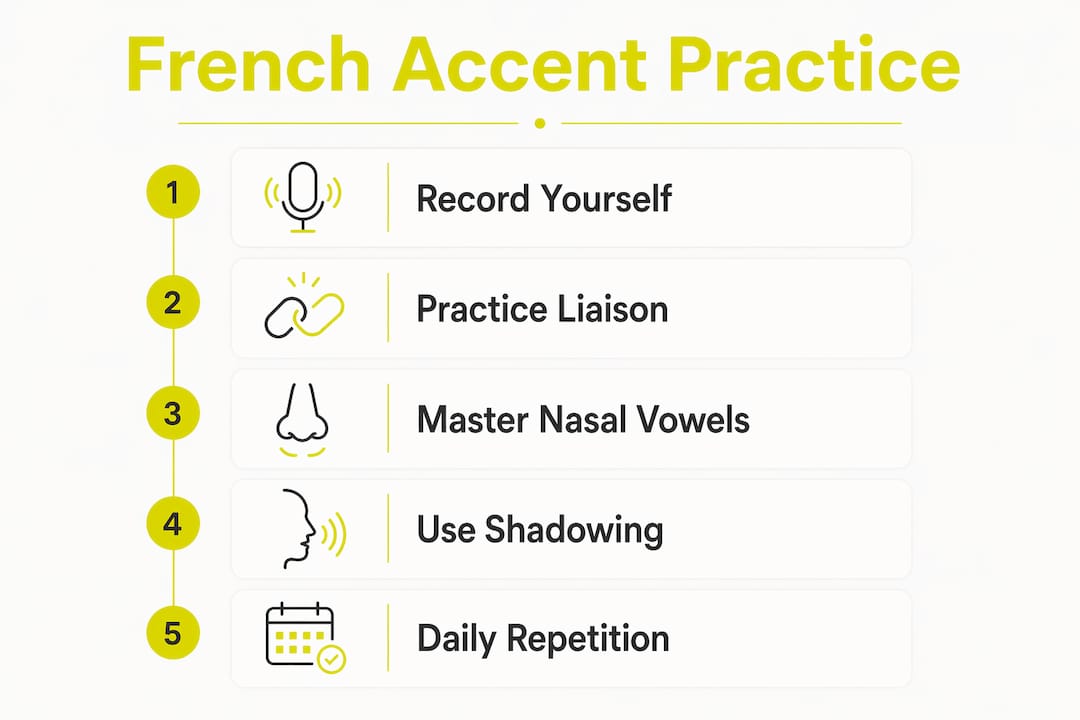
Liaison and enchaînement are the two linked-speech processes that give French its characteristic smooth, flowing rhythm. Confusing them or ignoring them produces speech that sounds choppy and foreign even when individual sounds are correct.
Liaison reveals a normally silent final consonant when the next word begins with a vowel sound. The phrase les amis is pronounced “lay-za-mee,” not “lay-ah-mee.” The “s” in les is normally silent but surfaces because amis starts with a vowel. Liaison is mandatory in some grammatical contexts, optional in others, and completely prohibited in a few. Getting the rules right separates intermediate learners from advanced speakers.
Enchaînement carries over an already pronounced consonant smoothly to the next word starting with a vowel. In elle arrive, the “l” of elle merges with arrive to produce “e-la-rive.” Unlike liaison, enchaînement always applies when the conditions are met. There is no optional or prohibited category. Mastering both processes is non-negotiable for natural French speech and listening comprehension because wrong linking rules directly harm intelligibility.
| Linking type | Trigger | Example | Result |
|---|---|---|---|
| Mandatory liaison | Determiner + noun | les enfants | “lay-zan-fan” |
| Optional liaison | Verb + subject (formal) | ils arrivent | “il-za-reev” (formal) |
| Prohibited liaison | Noun + verb | Paris est | “Pa-ree eh” (no linking) |
| Enchaînement | Pronounced consonant + vowel | elle arrive | “e-la-reev” |
The best way to practice liaison is to read French text aloud with exaggerated linking at first. Slow down, find every vowel-initial word, and consciously connect the preceding consonant. Use audio resources like RFI’s Journal en français facile to hear these links in real speech. After two weeks of exaggerated practice, the connections become automatic at normal speed.
What is the shadowing technique and how can you apply it to French accent practice?
Shadowing is defined as the immediate repetition of native audio while simultaneously focusing on rhythm, mouth shape, and intonation. It is not translation. It is not grammar analysis. Active reproduction through shadowing and mouth-position training creates the motor learning that actually changes your accent. Passive listening, no matter how many hours you log, does not.
The evidence is clear: repeating one realistic sentence 20 times improves rhythm, intonation, and pronunciation far more than memorizing many random words. The repetition builds a physical memory in your mouth, not just a mental note in your brain. This is why shadowing works where vocabulary drills fail for accent improvement.
Here is a practical shadowing routine you can start today:
- Choose a short audio clip of 30 to 60 seconds from a French podcast, film dialogue, or news broadcast. RFI and France Inter both offer free audio with transcripts.
- Listen to the clip once without doing anything. Focus only on the rhythm and melody of the speech.
- Play it again and shadow immediately, speaking at the same time as the native speaker. Do not pause to think about meaning.
- Replay the same clip and shadow again, this time focusing on one specific sound you missed (often the French R or a nasal vowel).
- Record your third or fourth attempt and compare it directly to the original.
- Repeat the same clip for the entire session before moving to new material.
Two sessions of 10 to 15 minutes per day produce better results than one long session. Short, focused repetition is how motor memory forms. For improving pronunciation through shadowing, the material you choose matters as much as the technique. Dialogues and interviews work better than formal speeches because they contain the connected speech patterns you will actually use.
Pro Tip: Use a voice memo app to record every shadowing session and label it by date. Listening back to sessions from three weeks ago is often the clearest proof that the method is working.
How can you develop a daily practice workflow to steadily improve your French accent?
A structured 3-month accent plan recommends 30 to 60 minutes of daily native exposure plus two shadowing sessions of 10 to 15 minutes each. The plan progresses through three phases: diagnosis in month one, automation in month two, and spontaneity in month three. Each phase builds on the last, and external feedback from a tutor or language partner is built into the structure.
Consistent daily practice combining listening, shadowing, phonetic visualization, and external feedback produces significant accent improvement within months. Tools like Speechling (which gives human feedback on recorded pronunciation), ELSA (an AI-powered pronunciation coach), and Forvo (for checking individual word sounds) each serve a different function in your daily stack. Using all three in rotation covers listening, speaking, and self-assessment.
- Month 1 (Diagnosis): Record yourself reading 10 standard sentences. Identify your three weakest sounds. Focus all shadowing sessions on those sounds only.
- Month 2 (Automation): Expand to full paragraph shadowing. Add a weekly session with a tutor or language exchange partner on platforms like iTalki or Tandem for live feedback.
- Month 3 (Spontaneity): Practice in real conversations. Use what you have drilled in unscripted speech. Record conversations and review them for regression.
Music is one of the most underrated tools in this workflow. Songs force you to match exact rhythm, pitch, and connected speech at a pace you cannot control. Learning French with music trains your ear and mouth simultaneously in a way that drills alone cannot replicate. French artists like Stromae, Zaz, and Édith Piaf offer a range of speech speeds and regional accents worth exploring.
| Method | Best for | Frequency |
|---|---|---|
| Shadowing | Rhythm and intonation | Twice daily, 10-15 min |
| Forvo / Speechling | Individual sound accuracy | Daily, 5-10 min |
| Music-based practice | Connected speech and ear training | Daily, 15-20 min |
| Tutor or language partner | Real-time correction | Weekly |
For building a daily language practice workflow, the key is stacking habits rather than scheduling isolated study blocks. Shadow during your morning commute. Use Forvo to check pronunciation of new words as you encounter them. Sing along to one French song before bed. These micro-sessions accumulate faster than you expect.
Key takeaways
Mastering French pronunciation requires daily shadowing, targeted sound drills, and deliberate practice of liaison and enchaînement to produce natural, fluent speech.
| Point | Details |
|---|---|
| Shadowing beats passive listening | Immediate repetition of native audio builds motor memory that passive listening cannot create. |
| Target the hardest sounds first | The French R, nasal vowels, and the “u” vowel require specific mouth-position drills, not just exposure. |
| Liaison and enchaînement are non-negotiable | Wrong linking rules harm intelligibility even when individual sounds are correct. |
| Structure your 3-month plan | Progress through diagnosis, automation, and spontaneity phases with daily listening and shadowing targets. |
| Music accelerates accent training | Song-based practice trains rhythm, connected speech, and ear recognition simultaneously. |
Why the French accent clicked for me later than I expected
I spent the first year of learning French convinced that more listening would eventually fix my accent. It did not. The shift happened when I stopped treating pronunciation as a side effect of vocabulary growth and started treating it as a physical skill, like learning to type or play an instrument.
The French R was my personal wall for months. What finally broke through was not more audio. It was standing in front of a mirror, watching my mouth, and drilling uvular position for five minutes every morning before doing anything else. Unglamorous and repetitive. Completely effective.
What I underestimated was how much liaison and enchaînement affect comprehension, not just production. Once I started hearing the links between words, French audio that had sounded like one long blur suddenly separated into recognizable chunks. The two skills reinforce each other in a way that most pronunciation guides treat as separate topics.
My honest recommendation: record yourself on day one, week four, and month three. Do not rely on your own perception of progress. Your ear adapts to your own voice faster than your accent actually improves, which means you will underestimate how far you have come. The recordings tell the truth. And when you hear real improvement in your own voice, the motivation to keep going becomes self-sustaining.
— Ben
Practice French accents daily with Singwithcanary
Singwithcanary is built for exactly the kind of daily, music-driven accent practice this article describes. The platform combines karaoke-style song learning with vocabulary cards, pronunciation feedback, and a global community of learners who practice together in real time.
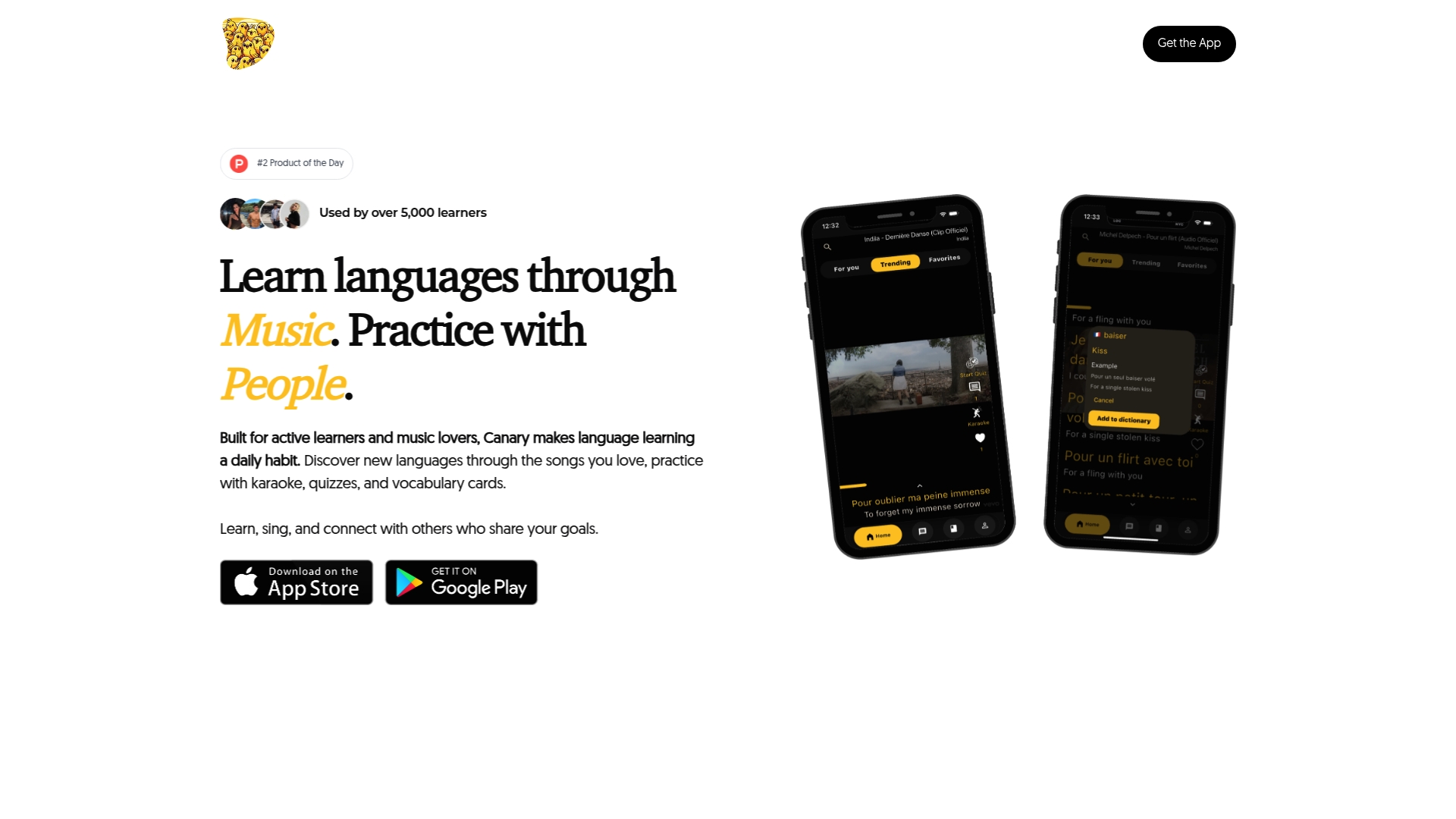
French learners on Singwithcanary practice connected speech and rhythm through real song lyrics, which means every session trains liaison, enchaînement, and intonation at once. The social layer adds the live feedback that solo drilling cannot provide. If you want to learn languages with music and build the kind of daily habit that actually moves your accent forward, Singwithcanary gives you the structure, the content, and the community to make it stick.
FAQ
What is the fastest way to improve a French accent?
Shadowing native audio with immediate repetition is the fastest method because it builds physical motor memory, not just mental recognition. Two 10 to 15 minute sessions daily produce faster results than longer, less focused practice.
What are the hardest French sounds for English speakers?
The French R, nasal vowels, and the rounded “u” vowel are consistently the most difficult for English speakers. Each requires specific mouth-position training rather than simple repetition of familiar sounds.
What is the difference between liaison and enchaînement?
Liaison makes a normally silent consonant audible before a vowel-initial word, while enchaînement carries an already-pronounced consonant smoothly into the next word. Both are required for natural French speech.
How long does it take to noticeably improve a French accent?
A structured 3-month plan with daily shadowing and listening produces noticeable improvement within the first month for most learners. Consistent external feedback from a tutor or language partner accelerates the timeline.
Can music really help with French pronunciation?
Yes. Song-based practice forces you to match exact rhythm, pitch, and connected speech patterns at a fixed pace. This trains the same skills as shadowing while adding ear training and vocabulary retention as secondary benefits.